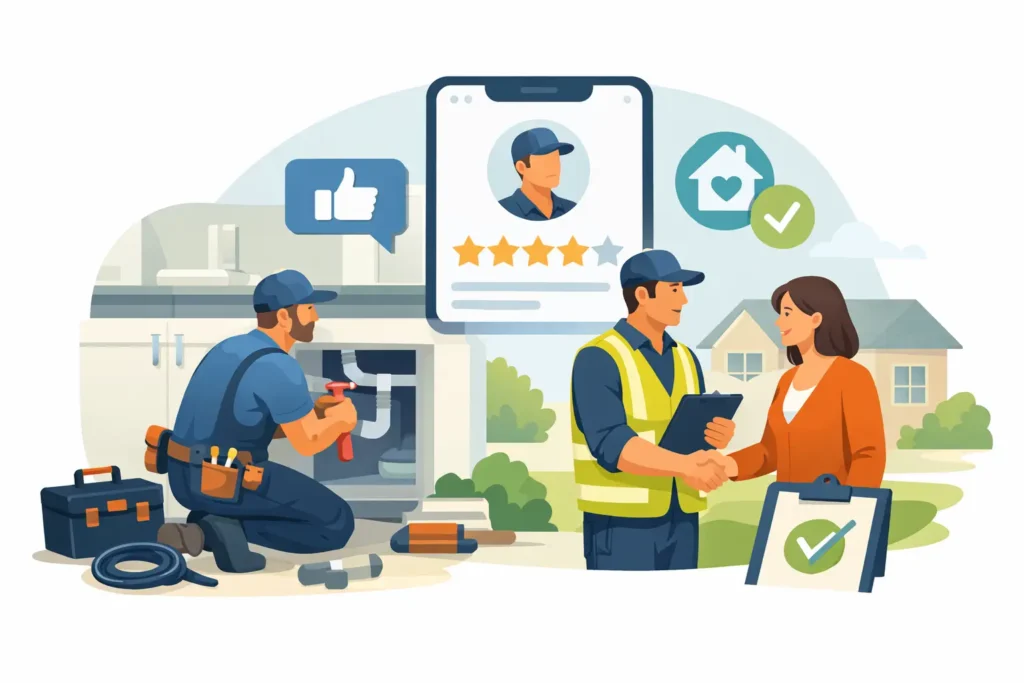
A bloke can spend thousands on a website, keep his ute signwritten, and still lose work to a competitor with a scrappier setup – simply because that competitor has 40 solid Google reviews and he has four. That is how much trust gets decided before a customer ever picks up the phone. Google reviews for tradies are not just a nice extra. They are often the thing that gets you the call.
If you are a plumber, sparky, builder, painter or landscaper, reviews do two jobs at once. They help your business look more trustworthy, and they help Google feel more confident showing you to local customers. That mix matters because most people are not comparing ten businesses in detail. They are scanning the map, checking ratings, reading a couple of comments, and calling the one that looks reliable.
Why Google reviews for tradies matter so much
When someone needs a tradie, they usually want two things straight away – someone who looks legit, and someone who seems likely to answer the phone. Your reviews help with both. A strong review profile tells people that real customers have used you, liked the work, and felt confident enough to leave feedback with their own name attached.
That matters more in trades than in a lot of other industries. Customers are inviting you to their home, trusting you around their family, and paying for work they may not fully understand themselves. If they are choosing between two electricians with similar service areas and similar websites, the one with better reviews usually wins.
Google also uses review signals as part of local visibility. Reviews are not the only ranking factor, and anyone telling you they are the whole game is oversimplifying it. But quantity, quality, recency and relevance all help build a healthier Google Business Profile. In plain English, more good reviews can improve your chances of showing up when someone nearby searches for the service you do.
What customers actually look for in your reviews
Most tradies assume customers only care about the star rating. The rating matters, but it is not the full story. People read reviews for clues. They want to know whether you turned up on time, explained the job clearly, cleaned up after yourself, and charged fairly for the work.
They also look for patterns. One review saying you were great is useful. Ten reviews saying you were punctual, honest and easy to deal with is powerful. That is when trust starts to build properly.
Detailed reviews are often better than vague ones. A comment like, “Jake replaced our hot water system the same day and explained everything clearly” does more for your business than “good service” ever will. It tells the next customer what kind of job was done and what it felt like to deal with you.
That is why the best review strategy is not just getting more reviews. It is getting the right kind of reviews from real customers, consistently.
How to get more Google reviews for tradies without making it awkward
Most tradies do not have a review problem because customers are unhappy. They have a review problem because they never ask. By the time the invoice is sent and the tools are back in the ute, the moment has passed.
The easiest fix is to make asking part of your normal process. When the customer is happy and the job is finished, ask while the good experience is still fresh. Keep it simple. Something like, “If you were happy with the job, would you mind leaving us a quick Google review? It really helps.” That works better than a long speech.
Timing matters. Ask after the problem has been solved, not while the customer is still waiting on a part or deciding whether the final result is what they expected. A review request sent too early can backfire.
It also helps to remove friction. If people have to search for your business and work out where to leave the review themselves, plenty will never get around to it. Send a direct review link by text or email. For tradies, SMS often works better because customers can do it on the spot from their mobile.
If you have a team, make sure everyone knows when and how to ask. Otherwise one person does it consistently and the rest forget. Reviews then come in bursts instead of building steadily.
The mistakes that hurt tradie review profiles
A lot of businesses know they need reviews but handle them badly. The first mistake is only chasing reviews when work goes quiet. That creates a stop-start pattern and usually means the profile stays weaker than it should be. Reviews work best when they come in regularly over time.
The second mistake is offering rewards or trying to game the system. Google is not keen on dodgy review practices, and customers can smell them too. A review profile only works if it feels real. That means genuine feedback from actual customers, even if not every review reads like a sales pitch.
Another common problem is ignoring reviews once they are posted. If someone leaves a positive review and hears nothing back, that is a missed opportunity. A quick reply shows you are engaged and appreciative. If someone leaves a negative review and it sits there unanswered, future customers notice that as well.
Then there is the one-star panic. A bad review feels personal, especially when you know how hard your team works. But one poor review does not ruin your profile if the rest of your reviews are strong and your response is calm. In some cases, a sensible reply makes you look more professional than a perfect five-star average with no context.
How to respond to reviews without sounding scripted
Good review replies do not need to be long. They just need to sound like a real business run by real people. Thank the customer, mention the job if relevant, and keep the tone natural. You are not writing an essay.
For example, if someone says you fixed an urgent leak quickly, thank them for the feedback and say you were glad you could help. That is enough. Short, genuine replies show future customers that you care and that your business is active.
Negative reviews need a bit more care. Do not argue in public, even if the review is unfair. A defensive response can do more damage than the original complaint. A better approach is to acknowledge the issue, keep it professional, and offer to sort it out offline.
That does not mean rolling over if the review is false. It means staying measured. Anyone reading it later will judge your response as much as the complaint itself.
Reviews help your rankings, but they also help conversions
This is the part many businesses miss. Reviews are not only about getting seen on Google. They are about what happens once people do see you.
A strong review profile improves click-through because customers feel more comfortable choosing you from the map results. Then, when they land on your website or Google Business Profile, those reviews keep doing the heavy lifting. They reduce hesitation. They answer doubts before a call happens. They make your business feel safer to contact.
That is especially important for higher-value jobs. For a small repair, someone might call the first decent option they find. For a bigger renovation, rewiring job, retaining wall or bathroom fit-out, they are more cautious. Reviews become part of the proof that you know what you are doing and can be trusted in someone else’s home.
This is also where review quality matters more than just numbers. Fifty reviews with no substance can still look weak. Twenty strong reviews that mention specific jobs, good communication and reliable service can convert better.
What a healthy review strategy looks like
A good review setup is not complicated. It is consistent. You finish the job, make sure the customer is happy, ask for the review, and send the direct link. Then you reply to the review once it comes in.
Over time, this creates a profile that looks alive, trustworthy and relevant to the work you actually want more of. If you want more switchboard upgrades, kitchen renovations, paving jobs or roof repairs, the reviews should reflect that. That way your profile speaks to the next customer searching for the same thing.
For local businesses around Perth and the Perth Hills, this matters even more because people are often choosing from a handful of nearby operators. In that situation, the difference between getting the call and missing out can be as simple as having recent, credible reviews that make a customer feel confident enough to reach out.
If your Google reviews are thin, outdated or inconsistent, it is usually not a sign your business is doing poorly. It is a sign the process has not been set up properly yet. Once it is, reviews stop being something you chase when things are quiet and start becoming part of how you win work week after week.
If you want more enquiries from Google, start with the trust signals customers already look at first. A good review profile will not fix every marketing problem, but it gives people a clear reason to choose you – and sometimes that is all it takes to keep the phone ringing.