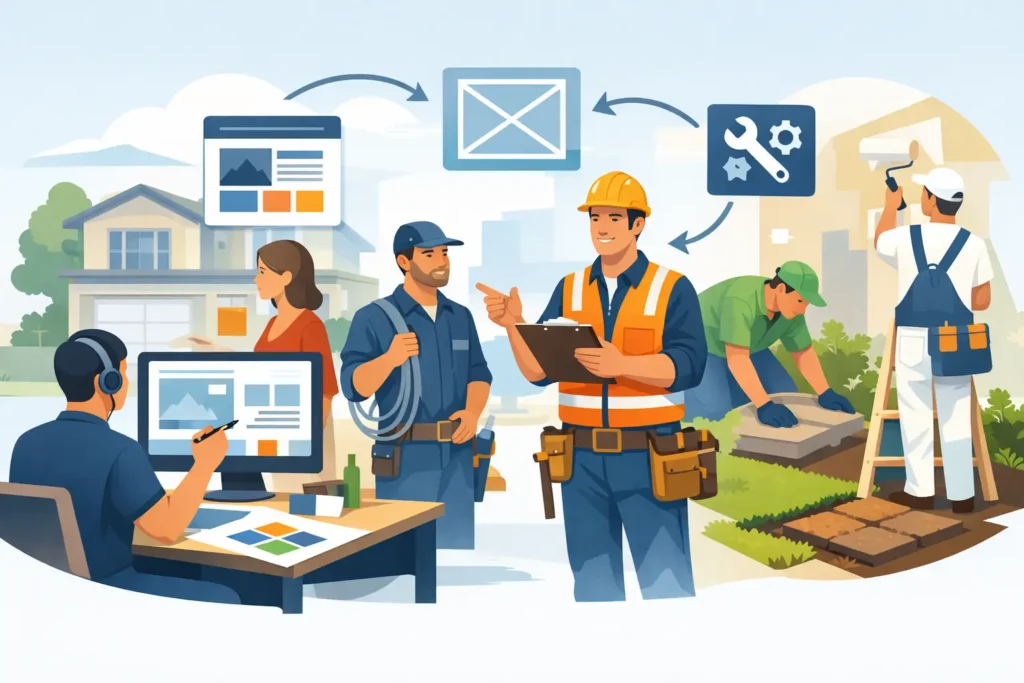
A lot of tradie websites fail before anyone even picks up the phone. They look dated, load slowly, bury the contact details, or say plenty without making it clear why a customer should call. A proper custom website design process fixes that. It gives your business a site built around how local customers search, what they want to see, and what gets them to enquire.
For plumbers, sparkies, builders, landscapers and other service businesses, a website is not there to win design awards. It needs to bring in calls, quote requests and booked work. That means the process matters just as much as the finished site. If the planning is wrong, the end result usually looks fine on the surface but does very little for the business.
Why the custom website design process matters
A template site can be quick, but quick is not always the same as effective. If your business has different services, specific service areas, strong reviews, emergency callouts, or a team people want to trust before letting on site, those details need to be built in properly.
A custom website design process helps shape the site around your actual goals. Maybe you want more phone calls for urgent jobs. Maybe you want better quality leads for bigger work. Maybe your current website gets traffic but not enough enquiries. The right process looks at those goals first, then builds the website to support them.
That is also where a lot of tradies waste time with the wrong provider. They get asked what colours they like before anyone asks what kind of jobs they want more of. Good design matters, but not ahead of visibility, trust and conversion.
Step 1: Start with how your business wins work
Before anything gets designed, the first job is understanding how your business actually operates. That means looking at your main services, the areas you cover, the kinds of customers you want, and how people usually contact you.
A plumber doing blocked drains and emergency work needs a different setup from a builder chasing larger renovation projects. One needs fast contact paths and clear urgency. The other may need project galleries, stronger trust signals and service pages that explain the process clearly.
This stage should also uncover what is not working right now. Maybe your current site is too vague. Maybe it talks too much about the business and not enough about customer problems. Maybe there is no clear service area focus, so it struggles to show up in local search.
Without that groundwork, the rest of the site becomes guesswork.
Step 2: Plan the pages around real search intent
This is where a custom website design process starts to separate itself from a generic build. The site structure should reflect what people are actually looking for, not just what sounds nice in a menu.
If someone searches for hot water repairs, switchboard upgrades, bathroom renovations or retaining walls, they want a page that speaks directly to that service. If they are in a local area, they also want to know you work there. That is why proper planning often includes dedicated service pages and, where it makes sense, local area pages.
There is a trade-off here. You do not want dozens of thin pages saying the same thing with suburb names swapped out. But you also do not want one catch-all services page trying to rank for everything. The best approach usually sits in the middle – enough detail to be useful, focused enough to match local search, and clear enough for customers to act.
Step 3: Write for customers, not for the industry
A lot of tradie websites are filled with broad claims like quality workmanship, reliable service and competitive rates. Every second site says the same thing. It does not help someone choose.
Good website content is plain, specific and easy to scan. It explains what you do, who it is for, what areas you service, and what the next step is. It answers the basic questions customers ask before calling, such as whether you handle urgent jobs, whether you work on residential or commercial properties, and how quickly you can respond.
This part matters because content is doing two jobs at once. It helps Google understand the page, and it helps the customer decide whether to trust you. If the writing is vague, overloaded with jargon or padded out for the sake of it, both jobs suffer.
Step 4: Design for trust and action
Once the structure and messaging are right, the design should support the outcome. For most tradies, that means making it dead simple for people to call, enquire or request a quote.
Your phone number should be easy to find. Contact buttons should appear where people expect them. Testimonials, reviews, photos of actual work, service areas and licences or qualifications should be visible without forcing people to go hunting.
This is where custom design pays off. Instead of cramming your business into a generic layout, the site can prioritise what matters most. For one business that may be emergency call buttons and fast mobile contact. For another it may be before-and-after project images, suburb-specific proof and a stronger quote form for larger jobs.
Looks still matter, of course. A clean, modern site helps build confidence. But a polished design with poor calls to action is still a poor sales tool.
Step 5: Make mobile the priority
Most local customers are not sitting at a desk when they search for a tradie. They are on their mobile, often wanting an answer fast. If your site is awkward on mobile, too slow, or hard to navigate with one hand, you lose work.
That is why the custom website design process should treat mobile performance as a priority, not an afterthought. The key details need to show up quickly. Tap-to-call should be obvious. Forms should be short enough that people will actually use them. Text should be readable without zooming in.
There is no point having a beautiful desktop layout if your real customers mostly see the mobile version and give up after ten seconds.
Step 6: Build local SEO into the website from the start
For local service businesses, website design and local SEO should not be treated as separate jobs. If the site is built first and search is bolted on later, important pieces are often missed.
A website that is designed properly for local search includes the right service focus, clear location signals, page titles and headings that make sense, content that matches what people search for, and a structure that supports your Google Business Profile rather than competing with it.
For businesses across Perth and the Perth Hills, local relevance matters. People want someone nearby who can do the job properly and respond without mucking them around. Your website should make that clear without stuffing location names into every second sentence.
Step 7: Test what gets enquiries
Launching the site is not the end of the job. A website can look good on launch day and still underperform if key details are missed.
Testing should cover more than whether the pages load. It should check whether forms work properly, whether mobile buttons are easy to use, whether contact details are consistent, and whether the most important pages guide people toward action.
Sometimes the fixes are small but make a big difference. A stronger headline, a better-placed call button, clearer wording around service areas, or a shorter quote form can lift enquiry rates noticeably. That is why websites built for lead generation need ongoing attention, not just a handover and silence.
What tradies should expect from a good custom website design process
A solid process should feel straightforward, not confusing. You should know what is happening, what is needed from you, and how the website is being shaped to bring in work. If the conversation is all about fonts and not enough about leads, that is usually a warning sign.
You should also expect honesty. Not every business needs a huge website. Not every service needs its own page. Not every enquiry problem is caused by the site alone. Sometimes the issue is poor local visibility. Sometimes it is weak reviews. Sometimes the traffic is fine, but the messaging is off. A good process looks at the full picture and fixes the parts that matter most.
That is where working with someone who understands tradie businesses makes a difference. Yazoogle focuses on websites that do the practical job – getting local service businesses seen, trusted and contacted by the right customers.
The end goal is not a website
Most tradies do not wake up wanting a new website. They want the phone to ring more often, better jobs coming through, and less time wasted on tyre-kickers. The website is just the tool.
So if you are looking at a rebuild, focus less on fancy talk and more on the process behind it. A proper custom website design process should make your business easier to find, easier to trust and easier to contact. That is what turns a website from an online brochure into something that actually helps fill the diary.