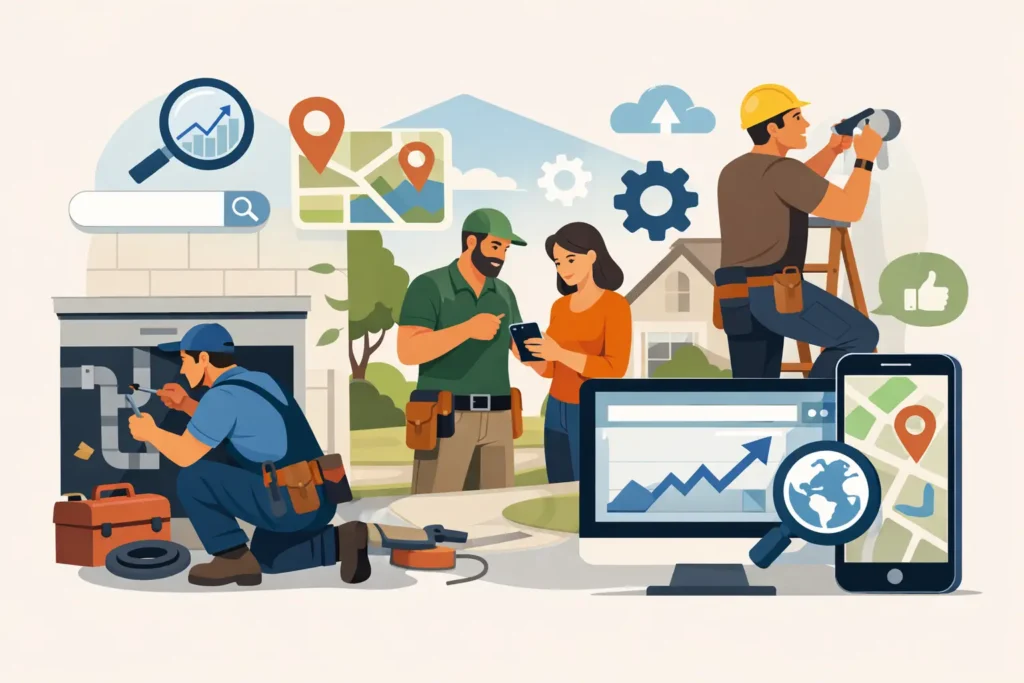
A bloke with a leaking hot water system usually does not ask around for three days. He grabs his mobile, types in what he needs, and calls one of the first businesses that looks trustworthy. That is why the question do small businesses need SEO is not really about marketing theory. It is about whether your business shows up when local customers are ready to book.
For tradies and service businesses, SEO is not some extra nice-to-have sitting off to the side of the business. It is part of how people find you. If your website is hard to find, your Google Business Profile is half-finished, or your suburb pages are missing, you are handing work to whoever appears above you.
Do small businesses need SEO if referrals already bring in work?
Sometimes business owners ask this because they already get jobs through word of mouth. That is fair enough. Referrals are still one of the best ways to win work, especially in local service industries.
The issue is that referrals often lead straight back to Google anyway. Someone gets your name from a mate, then searches your business to check reviews, look at your website, confirm your service area, and see whether you look legitimate. If they find nothing useful, or they find a tired old site that looks abandoned, confidence drops fast.
SEO helps at both ends. It helps people who have never heard of you find you in the first place, and it helps referred customers feel comfortable enough to call. So even if referrals are strong, being visible in search still matters.
What SEO actually means for a small local business
A lot of business owners hear SEO and think it means technical jargon, long reports, or chasing national rankings that do nothing for the phone. For a local business, good SEO is much simpler than that.
It means showing up where nearby customers are searching. It means having a website that clearly says what you do, where you work, and how to contact you. It means your Google Business Profile is active, your reviews are solid, and your pages give people enough trust to take the next step.
For a plumber, sparkie, builder or landscaper, SEO is not about attracting everyone. It is about getting found by the right people in the right suburbs at the right time.
Why local SEO matters more than broad visibility
Most small service businesses do not need to rank across the whole country. They need to show up in their patch. If you work in Perth, the Perth Hills, Midland, Mundaring or surrounding areas, those are the searches that count.
That is where local SEO earns its keep. When someone searches for a service plus a suburb, or searches on maps while standing in their driveway with a problem to solve, Google looks for local relevance. It wants to show businesses nearby that seem established, useful and trustworthy.
If your business has no location signals, weak service pages, missing reviews or patchy profile information, you make Google’s job harder. Usually that means lower visibility.
The real question is not whether you need SEO
The real question is how much missed work you are comfortable with.
If you are already booked out months ahead on profitable jobs and turning work away every week, SEO might not be urgent. Even then, there is still value in protecting your visibility so the pipeline stays healthy when the market slows or seasons shift.
But if you have quiet weeks, rely too heavily on one lead source, or know your website is not pulling its weight, then SEO is not optional. It is one of the most practical ways to build a steadier stream of enquiries.
This is where a lot of small businesses get stuck. They assume no calls from Google means people are not searching. Usually the searches are happening. The business just is not visible enough, or the website is not convincing enough once people land on it.
What happens when a small business ignores SEO?
Nothing dramatic happens overnight. That is why it gets ignored for so long.
You still get some work. A few referrals come through. Maybe your Google Business Profile picks up the odd call. But over time, the businesses that keep their online presence in shape start taking a bigger share of local enquiries.
They appear more often. They collect more reviews. Their websites answer questions faster. They look more current and more reliable. Bit by bit, they become the safer choice.
Ignoring SEO does not usually kill a business in a week. It just quietly limits growth. It leaves too much work on the table and makes you more dependent on luck, repeat customers, or one source of referrals.
Do small businesses need SEO or just a good website?
You need both, because one without the other leaves a gap.
A good website helps turn visitors into calls and enquiries. SEO helps get the right visitors there in the first place. If the site looks sharp but nobody finds it, it is not doing enough. If people do find it but it is slow, outdated or unclear, you still lose the lead.
This is especially true for tradies. Most customers are not studying ten websites in detail. They scan quickly. They want to know what you do, where you work, whether you are credible, and how to contact you. If that process feels clunky, they move on.
So SEO is not separate from your website. It works with it. The best results usually come when the site is built to rank locally and convert cleanly.
The parts of SEO that matter most for tradies
Not all SEO work is equally useful. For local service businesses, the highest-value basics are usually the simplest.
Your Google Business Profile needs to be complete and accurate. Your website needs clear service pages and location signals. Your contact details need to be consistent. Your reviews need attention. And your site needs to load properly on mobile, because that is where a lot of your traffic comes from.
Good SEO also means writing pages for real services, not vague filler. A page about blocked drains in your service area is more useful than a generic page full of marketing fluff. The same goes for electrical work, roofing, concreting, painting and every other local service. Clear beats clever every time.
When SEO works best for small businesses
SEO works best when the business is already set up to answer the phone, respond quickly, and convert enquiries into booked work.
That sounds obvious, but it matters. More visibility only helps if the leads are handled properly. If calls go unanswered, quote requests sit untouched, or the website makes it hard to get in contact, better rankings alone will not fix the problem.
That is why practical businesses tend to get the best value from SEO. They do the basics well. They show up, follow up, and make it easy for customers to take action.
When SEO might not be your first priority
There are cases where SEO should not be the first thing you tackle.
If your business has no proper website, no clear service offering, or poor follow-up, those issues may need fixing first. If you are taking on more work than you can handle already, the smarter move might be tightening operations before pushing for more leads.
SEO is effective, but it is not magic. It works best when the foundation is solid. That means a business people can trust and a website that helps them act.
So, do small businesses need SEO?
For most local service businesses, yes.
Not because SEO is trendy, and not because every business needs some huge ongoing campaign. They need it because customers use Google to choose who to call. If you are not visible there, or you look second-rate when people find you, you lose enquiries to businesses that have done the basics better.
The good news is that small business SEO does not need to be overcomplicated. It needs to be local, practical and tied to results. More visibility in the right suburbs. More trust when people check you out. More calls from customers who are ready to get the job sorted.
If your business depends on local enquiries, search visibility is not background noise. It is part of how work lands in the diary. And once that clicks, SEO stops sounding like marketing and starts looking like what it really is – a way to make sure good customers can actually find you.