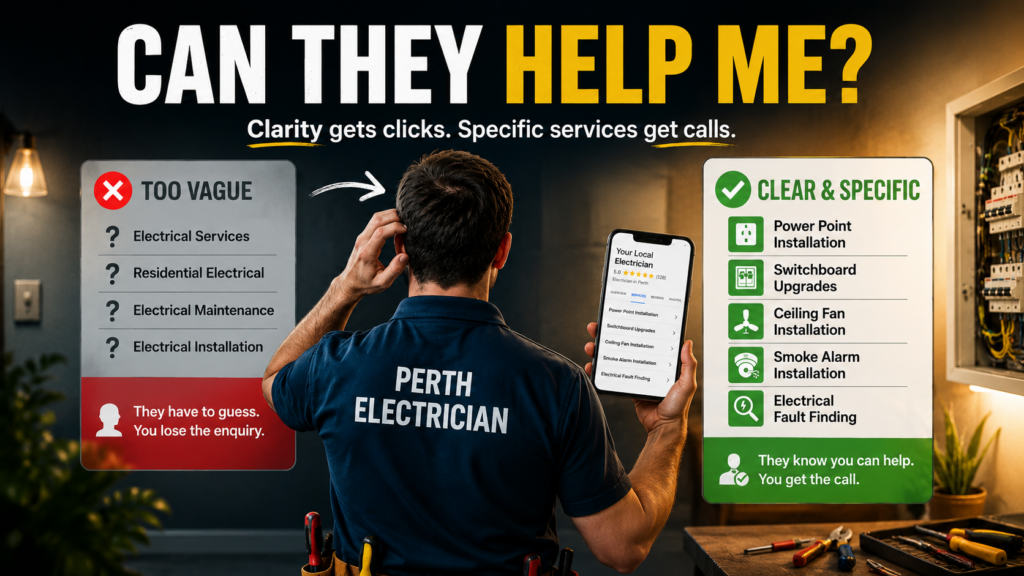
A homeowner looking for an electrician usually isn’t approaching Google with the mindset of an electrician. They aren’t thinking about how an electrical contractor categorises services internally. They’re thinking about the thing they need fixed, installed, replaced or checked.
That creates a deceptively simple problem for Perth electricians using Google Business Profile. A business can accurately describe itself as offering “Electrical Services” and still leave a potential customer unsure whether it actually does the job they need. The wording is technically correct, but the customer has been given work to do. They have to investigate, interpret or guess.
A more useful way to judge every service listed on a Google Business Profile is to ask one question: Can a homeowner immediately tell whether this business handles the problem they have? That is the “Can You Help Me?” test. It shifts the purpose of a service list from describing the business to helping the customer recognise their situation.
Accurate Isn’t Always Clear
One of the easiest mistakes to make in local business marketing is assuming that accurate wording is automatically useful wording.
Consider an electrician whose Google Business Profile lists:
- Electrical Services
- Residential Electrical
- Electrical Maintenance
- Electrical Installation
There may be nothing technically wrong with those descriptions. The problem is that they require interpretation.
Imagine a Perth homeowner whose switchboard is old and who has been told it may need upgrading. They find two electricians nearby.
The first profile says “Residential Electrical Services.”
The second says “Switchboard Upgrades.”
Both businesses might perform exactly the same work. But only one has immediately answered the customer’s question.
That distinction matters because customers rarely evaluate a Google Business Profile as if they were reading a company brochure. They are trying to resolve uncertainty. They want to know whether it is worth clicking, calling, requesting a quote or moving on to another business.
A useful rule is:
Broad service wording describes the business. Specific service wording helps the customer recognise themselves.
Those are not the same job.
The Customer Shouldn’t Have to Translate Your Services
Trade businesses naturally develop their own way of grouping work. It makes operational sense. An electrician may think in terms of residential work, commercial work, installation, maintenance or fault finding.
Customers often think differently.
A homeowner might be thinking:
“My safety switch keeps tripping.”
“I need another power point in the kitchen.”
“The ceiling fan in the bedroom needs replacing.”
“Our switchboard is ancient.”
“I want outdoor lighting installed.”
Those aren’t necessarily the categories the electrician would use to organise the business. They are situations.
This is where the “Can You Help Me?” test becomes useful. Take each service description and imagine a customer arriving with one specific problem. Does the wording allow that customer to recognise that their job belongs there?
“Electrical Services” doesn’t tell someone whether you install ceiling fans.
“Electrical Installations” might include power points, but the homeowner has to know that.
“Power Point Installation” removes the interpretation.
“Switchboard Upgrades” removes the interpretation.
“Ceiling Fan Installation” removes the interpretation.
Specificity isn’t about making the service sound more impressive. It is about reducing the distance between the customer’s problem and the business’s answer.
Every Extra Question Creates a Small Decision
Suppose a homeowner in Perth wants two additional power points installed in a home office.
They search for an electrician and open a Google Business Profile. The services section says “Domestic Electrical Work.”
Now a small sequence of questions begins.
Does domestic electrical work include adding power points?
Do they only do larger jobs?
Should I visit the website?
Where on the website would this service be listed?
Should I call and ask?
Would another electrician make this easier to figure out?
None of those questions is particularly difficult. That is precisely why the problem is easy for a business owner to underestimate.
The customer doesn’t need to become completely confused for vague wording to matter. They only need to encounter slightly more uncertainty than they encounter with another option.
Now imagine the next electrician’s profile includes “Power Point Installation.”
The customer doesn’t have to investigate whether the service fits. They can move to the next decision: whether this is the electrician they want to contact.
That is the deeper mechanism behind the test. Good service wording moves the customer forward instead of making them stop and decode what the business means.
The service list therefore isn’t merely a catalogue. It is part of the customer’s decision path.
Specific Services Also Help Customers Self-Select
Clear service wording does more than answer “Do they do this?”
It also helps potential customers decide whether they are a sensible fit before they make contact.
Consider a Perth electrical contractor that particularly wants residential jobs involving switchboard upgrades, smoke alarm installation, ceiling fans, lighting work and additional power points.
If its profile simply says “Electrician” and “Electrical Services,” almost none of that preference is visible.
A more specific service list starts shaping expectations before the phone rings.
Someone needing a ceiling fan can recognise the fit.
Someone researching a switchboard replacement can recognise the fit.
Someone who only knows they need “an electrician for something electrical” may need to investigate further.
This doesn’t mean a Google Business Profile should contain every tiny variation of every job the business could conceivably perform. That creates a different problem: clutter.
The useful target is not maximum detail. It is recognisable detail.
A service earns its place when naming it separately removes a meaningful doubt a real customer is likely to have.
That creates a practical decision rule. Don’t ask, “Can we technically perform this job?” Ask, “Would naming this job separately help the right customer recognise that we can help them?”
Use the “Do You Do…?” Questions as Evidence
Electricians already have a valuable source of information for improving their service wording: the questions customers ask.
Pay attention to sentences beginning with:
“Do you do…?”
“Can you install…?”
“Do you replace…?”
“Can you fix…?”
“Do you work on…?”
Repeated questions reveal where customers are uncertain.
If people regularly call and ask, “Do you install ceiling fans?” even though the website says “Electrical Installations,” that is useful feedback. The business understands that ceiling fan installation belongs inside electrical installations. The customer clearly does not find that relationship obvious enough.
The repeated question exposes a translation gap.
Instead of treating these questions merely as enquiries to answer, use them as a diagnostic tool. They show where the business’s language and the customer’s language have stopped matching.
For example, an electrician might discover that customers repeatedly ask about:
- Power point installation
- Switchboard upgrades
- Ceiling fan installation
- Smoke alarm installation
- Electrical fault finding
Those phrases may be more useful service descriptions than a collection of broad category labels because they answer questions customers are already demonstrating that they have.
This is one reason actual customer conversations can be more revealing than sitting down and trying to invent a perfect service list from scratch.
Run the Test From the Homeowner’s Side
The easiest way to audit a Google Business Profile is to stop reading it as the business owner.
Take one service at a time and imagine that you know nothing about the trade.
Then ask:
“If I had this particular problem, would this wording tell me that these people can help?”
If the answer is “probably,” the wording may still be too broad.
If the answer depends on understanding industry terminology, the wording may still be too broad.
If the customer would need to open the website to confirm what the service actually includes, there may be an opportunity to make the profile clearer.
This doesn’t mean technical terminology should always disappear. Sometimes the technical term is exactly what customers know and use. “Switchboard upgrade,” for example, can be both technically meaningful and customer-recognisable.
The test isn’t “avoid trade language.”
The test is remove unnecessary interpretation.
That is a much better standard because it works across different services, different electricians and different types of customers.
Make the Service List Answer Before the Customer Has to Ask
A strong Google Business Profile services section should quietly answer a series of small questions before the customer needs to ask them.
Do you install power points?
Do you upgrade switchboards?
Do you install ceiling fans?
Do you handle the particular electrical job I have in mind?
The goal isn’t to write the longest service list in Perth. It is to make the important jobs recognisable quickly enough that the right customer doesn’t have to investigate what your business means.
So when reviewing an electrician’s Google Business Profile, don’t start by asking whether every description is technically correct.
Start with the customer standing on the other side of the screen.
Pick a real job they might need done, read the service wording exactly as they would see it, and ask:
“Can I tell, immediately, that these people can help me?”
If the answer isn’t an easy yes, the service description still has work to do.
YOUR BONUS
Copy the following into your AI app and let it do it magic
Act as a customer-clarity auditor for a local electrical business and apply the “Can You Help Me?” test to the information I provide: [Paste your current Google Business Profile services list plus any recurring customer questions or common jobs you handle, for example: “Electrical Services, Residential Electrical, Electrical Maintenance, Electrical Installation. Customers often ask: Do you install ceiling fans? Do you upgrade switchboards? Can you add power points? We also do smoke alarms and electrical fault finding.”] Judge every current service from the perspective of a homeowner who knows what they need done but may not understand electrical trade categories. Identify which service names are too broad, technical, ambiguous, or likely to make the customer investigate further before knowing whether the business can help. For each weak entry, explain the specific uncertainty it creates and recommend a clearer customer-recognisable alternative only where the supplied information supports it. Then identify any important services or repeated “Do you do…?” questions that deserve their own service entry because naming them separately would remove a meaningful customer doubt. Rank your strongest recommended service entries in priority order, favouring recognisable detail over maximum detail, and avoid creating an unnecessarily long or repetitive list. Finish with a concise final Google Business Profile services list that a homeowner could scan quickly and answer, “Yes, these people handle the job I need.” Don’t invent services, qualifications, locations, capabilities, pricing, guarantees, statistics, or claims that aren’t supported by my information, and clearly label any useful inference as an inference.