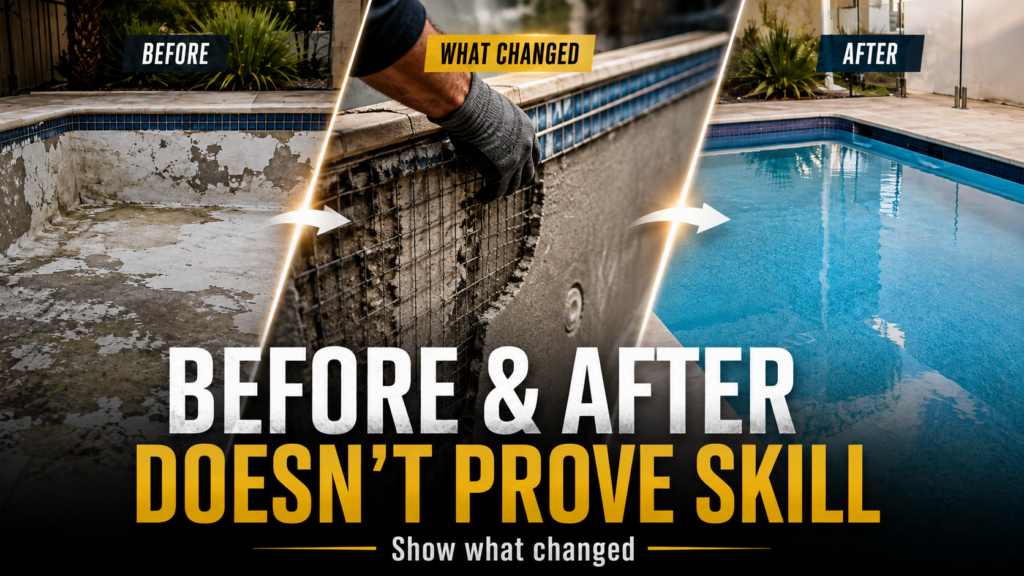
Before-and-After Photos Don’t Prove Skill Unless You Show What Changed
Before-and-after photos are one of the most natural forms of marketing for a trade business. They are easy to understand, they create an immediate visual contrast, and they appear to offer proof that real work has taken place. For a Perth tradie trying to show the quality of completed jobs on Facebook, Instagram, a website or Google Business Profile, it seems obvious that the stronger the transformation looks, the stronger the marketing should be.
The difficulty is that a visual transformation does not automatically communicate workmanship. A potential customer can often see that something looks newer, cleaner, straighter or more attractive without understanding what was technically wrong in the first place, what needed to be corrected, or what professional judgement was required to produce the finished result. The tradie sees a sequence of decisions, preparation, repairs and technical work. The customer often sees only “before” and “after”.
That gap matters because customers are not only deciding whether they like the finished result. They are also trying to judge whether the business appears competent, careful and worth trusting with their own property. If your content shows only the visible transformation, some of your strongest evidence may be missing entirely.
The more useful approach is to treat before-and-after content as a form of proof rather than simply a form of presentation. The question is not, “Does the finished job look good?” It is, “Can the customer see why this result required skill?”
The Finished Result Hides Most of the Work
Many trade jobs become less informative once they are finished. A correctly repaired wall may look completely ordinary. A properly prepared surface disappears beneath the final coating. Drainage work becomes invisible once paving or landscaping is complete. Electrical corrections disappear behind walls, ceilings and fittings. Structural repairs are often concealed by whatever comes next.
This creates a strange marketing problem. The better the job is completed, the less evidence of the difficult part may remain visible. A customer looking only at the final photograph may have no way of knowing whether the substrate was repaired, whether failed material was removed, whether levels were corrected, whether the area underneath was properly prepared, or whether the final finish was simply placed over an unresolved problem.
That is why two attractive photos can sometimes tell less of the story than a rough photograph taken halfway through the work. A cracked substrate, a corroded fitting, a poorly aligned structure or an exposed previous repair may not be visually impressive, but it can explain why the job required experience. It reveals the condition the tradie had to assess rather than merely displaying the finish the customer eventually sees.
For the business owner, this requires a change in thinking. Job photographs should not be collected only as a portfolio of completed work. They should also be collected as evidence of decisions.
The Evidence Gap Between “Before” and “After”
A useful way to assess a before-and-after post is to look for what might be called the Evidence Gap. This is the part of the job the customer must mentally fill in because your photographs have not shown it.
Imagine a Perth pool coating business posting a photograph of a tired, deteriorated concrete pool followed by a photograph of the completed recoated pool. The transformation may be dramatic, but the customer still does not know what happened between those two images. They cannot tell whether loose coating was removed, whether damage was found underneath, whether cracks required attention, whether the surface needed extensive preparation, or whether the final coating was simply applied over what was already there.
From the customer’s perspective, the story may be reduced to: “Old pool became blue pool.”
From the applicator’s perspective, the real story may have been quite different. The old coating had failed in several areas. Loose material had to be removed. Damaged sections needed preparation. The surface condition had to be assessed before the next stage could proceed. Those decisions are where much of the expertise sits, yet none of them are necessarily visible in the finished photograph.
The Evidence Gap Test is simple: What important part of this job would a customer still have to guess?
If the answer is preparation, hidden damage, underlying cause, alignment, repair method, site condition or some other technical factor, that is the evidence you should consider showing. You rarely need to document everything. One well-chosen image can be enough to change the meaning of the entire before-and-after sequence.
Show the Moment Professional Judgement Became Necessary
The strongest supporting image is not always a picture of someone working. Activity and expertise are not the same thing.
A photograph of someone sanding a wall shows labour. A photograph of the failed coating underneath, accompanied by a short explanation of why it had to be removed, shows judgement. A photograph of a plumber holding a tool shows activity. A photograph of the damaged connection discovered after access was opened explains why the repair was required. A photograph of a tiler applying adhesive shows process. A photograph of the uneven or damaged substrate that had to be corrected before tiling explains the problem being solved.
This distinction is important because generic work-in-progress images are easy to produce but often weak as evidence. Customers rarely need to be convinced that tradies use drills, grinders, ladders, paintbrushes or hand tools. What they need help understanding is why a particular step mattered on that particular job.
A useful rule is to photograph the moment where the job stops being obvious. That might be when an old surface is removed and hidden deterioration appears, when measurements reveal that something is out of alignment, when demolition exposes water damage, or when an earlier repair turns out to be inadequate. These are the points where knowledge affects the outcome.
For a Perth bathroom renovator, for example, the most powerful photograph may not be the glamorous completed bathroom. It may be the photograph taken after the old shower area was removed and damage underneath became visible. If the accompanying explanation says that the underlying problem had to be dealt with before new finishes were installed, the audience begins to understand why the finished bathroom is not simply a cosmetic makeover.
The photograph gives the claim substance.
Turn the Job Into a Problem, Evidence, Result Sequence
A reliable structure for trade content is Problem, Evidence, Result. It gives the customer enough information to understand both the transformation and the workmanship behind it without requiring a long technical explanation.
The first image establishes the visible problem. This is the condition the customer originally recognised: peeling paint, a leaking area, cracked tiles, damaged timber, an ageing pool surface, uneven paving or another obvious issue.
The second image provides evidence. This is the crucial stage. It might show the damaged substrate, the deteriorated material underneath, the preparation required, the incorrect alignment, the failed previous repair or the cause uncovered during the work.
The third image shows the completed result.
Consider a Perth roofer called to investigate a recurring leak. A standard before-and-after post might show the damaged area before the work and a tidy roof afterwards. The customer sees improvement, but the technical value remains vague.
A stronger sequence might show the water-damaged area inside the property, then the failed flashing or previous patch repair discovered during inspection, followed by the corrected roof work. Now the customer can follow the reasoning. There was a visible symptom, there was an identifiable cause, and the work addressed that cause.
The same framework works across many trades because it reflects how skilled work actually happens. A problem is observed. Evidence is gathered. A judgement is made. The issue is corrected. The visible result is only the final stage.
That sequence is far more persuasive than simply announcing “another quality job completed” because it allows the customer to see some of the reasoning for themselves.
Explain What the Customer Cannot See
Visual evidence becomes much stronger when the caption interprets it. Tradies often assume that a photograph speaks for itself because the defect is obvious to someone with industry experience. To the customer, however, the same photograph may simply look dusty, damaged or unfinished.
The purpose of the caption is not to give a technical lecture. It is to translate the significance of the evidence into language the customer can understand.
A weak caption might say:
“Surface prep underway in Canning Vale.”
A stronger explanation might say:
“Once the loose coating was removed, several damaged sections became visible. Those areas had to be repaired and prepared before the new coating could be applied.”
The second version tells the customer why the photograph matters. It connects the messy middle of the project to the quality of the finished work.
This is particularly useful when the most important work will eventually disappear. Waterproofing, substrate preparation, structural fixing, drainage, electrical corrections and surface repairs are often concealed by the finished job. If those stages are never documented, the customer has no way to distinguish them from a faster or more superficial approach.
You do not need to attack competitors or claim that others cut corners. The evidence can make the distinction without accusation. Showing what you found, what you considered and what you corrected allows customers to draw their own conclusions about the seriousness of the work.
The Best Job Photo May Be the One You Nearly Deleted
Trade businesses often save polished images and discard the ugly ones. That is understandable if photographs are being selected purely for a gallery. It is less useful if the goal is to demonstrate professional judgement.
The rough images are often where the expertise lives.
A photograph of rotten timber after cladding has been removed may explain a repair better than the perfect completed façade. A photograph of failed paint adhesion may explain why preparation mattered. A close-up of corrosion underneath an old finish may explain why simply recoating the visible surface would not have solved the problem. A photograph of a badly aligned installation may reveal why adjustment or rebuilding was necessary.
These images are not attractive in the traditional sense, but they create context. They answer the question every serious customer eventually asks: “What exactly am I paying you to know how to do?”
That is particularly valuable for businesses competing in markets where customers see large differences in quotations but struggle to understand why. A customer may not be capable of evaluating every technical detail, but they can usually understand that one business is showing how it identifies and deals with problems rather than simply promising “quality workmanship”.
The strongest content therefore does not rely on saying that you are careful, thorough or experienced. It makes those qualities visible through specific evidence.
Build the Habit Before the Job Is Finished
The challenge is that the evidence cannot always be recreated afterwards. Once the wall is closed, the pool is coated, the tiles are laid or the paving is complete, the most informative stage may be gone permanently.
That means the content process has to begin while the job is happening.
You do not need to turn every worksite into a photo shoot. You need a simple habit: whenever you encounter something that materially affects what you do next, take a photograph before you cover it, remove it, repair it or correct it. If a hidden problem changes the scope of the work, photograph it. If preparation is particularly important, photograph it. If something is visibly out of alignment, deteriorated or incorrectly installed, photograph it before the correction disappears into the finished job.
Over time, this creates a much richer library of content because you are no longer documenting only appearances. You are documenting reasoning.
Before you post your next before-and-after job, use one final test:
If I removed the finished photo, would the remaining evidence still show why professional judgement was required?
If the answer is no, you may have documented a transformation.
If the answer is yes, you have started documenting workmanship.
Turn Your Next Job Into Proof Of Your Workmanship
Copy this prompt, open your preferred AI tool, paste it in and replace the example information with details from one of your own jobs. It will help you identify the evidence customers need to see and turn your before-and-after photos into a stronger social media story.
Need Help With “Before-and-After Photos Don’t Prove Skill Unless You Show What Changed”?
Knowing what needs fixing is one thing. Getting it fixed properly is another. If you’d rather have an experienced digital marketer help you work through the problem and turn the advice into action, Yazoogle is here to help.
Get Help From Yazoogle