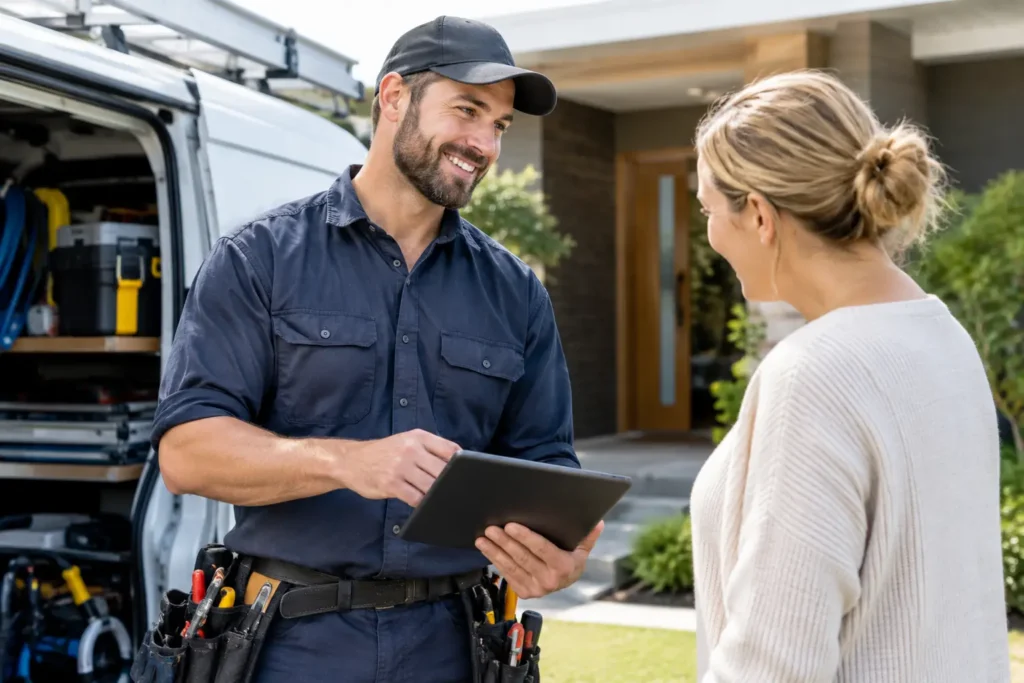
A customer with a burst pipe, faulty switchboard or leaking roof is not looking to admire your website. They are trying to work out one thing fast: can I trust this business to turn up, do the job properly and answer the phone?
That is what makes a website trustworthy. It is not flashy effects or clever marketing lines. It is clear proof that you are a real, capable local business that makes it easy for people to take the next step.
For tradies and service businesses, trust is often the difference between a website that gets looked at and one that gets calls. Here is what customers notice before they send an enquiry.
A trustworthy website looks like a real business
People are cautious online, particularly when they need to let someone into their home or spend money on an urgent repair. A bare website with vague wording, stock photos and no clear business details can make even a good operator look questionable.
Your site should immediately show who you are, what you do and where you work. Use your business name consistently, display a working mobile number, and make your service area clear. If you are a plumber servicing Midland, Mundaring and the Perth Hills, say so. Local detail reassures customers that they have found someone who actually covers their suburb.
Your email address matters too. An address using your own business domain looks more established than a generic free email account. It is a small detail, but customers use small details to make quick decisions.
A proper About page can help, especially for owner-operated businesses. You do not need your life story. A clear photo, a short introduction and a few lines about your experience give people a reason to feel comfortable calling. Customers want to know there is a real person behind the business, not a faceless lead form that disappears after payment.
Clear services beat vague claims
Saying you provide “quality workmanship” is fine, but every tradie website says it. It does not tell a customer whether you can solve their particular problem.
Trust grows when your website is specific. An electrician might list switchboard upgrades, smoke alarms, fault finding, power points and emergency electrical work. A landscaper might cover retaining walls, paving, drainage, turf and garden clean-ups. That level of detail helps customers recognise their job and feel confident you know what you are doing.
It also avoids wasted calls. If you do not do commercial fit-outs, major renovations or after-hours call-outs, be upfront. Trying to appeal to everyone can create enquiries that go nowhere. A trustworthy website sets realistic expectations from the start.
Explain the next step
People are more likely to contact you when they know what happens after they do. Tell them whether you will call back, arrange a site visit, provide a quote or book a job. Plain wording works best: “Call now for urgent repairs” or “Send photos of the job and we will get back to you.”
If you promise a response time, make sure you can meet it. A claim like “we respond within an hour” builds confidence only when someone genuinely answers the phone or returns the call.
Reviews are proof, not decoration
A strong Google review profile is one of the quickest ways to make a local service website more credible. Customers trust the experience of other local people, particularly when reviews mention the kind of work they need.
Do not just place a random five-star graphic on the homepage. Include real review excerpts where appropriate, using customer wording that shows reliability, communication and workmanship. Comments such as “arrived when he said he would”, “explained the issue clearly” and “left the place tidy” answer the concerns people have before they call.
Fresh reviews matter more than a large total from years ago. A business with recent feedback looks active and accountable. Make requesting reviews part of your job wrap-up process, not something you remember once every few months.
There is a trade-off here. A website crammed with testimonials can feel forced, especially if every review sounds identical. A handful of genuine, readable reviews placed near relevant services will do more work than a wall of five-star quotes.
Photos of real work build confidence
For trades, photos are evidence. They show customers the standard of your work and the type of jobs you take on. Real project images are far more convincing than generic pictures of someone holding a shiny wrench.
Use photos of completed jobs, your team, signwritten vehicles, before-and-after results and any relevant site conditions. A builder can show finished extensions. A painter can show clean lines and completed rooms. A landscaper can show a tired backyard turned into a usable outdoor area.
Keep the images clear and honest. You do not need a professional photoshoot for every job, but dark, blurry or messy photos can hurt confidence. Take a few decent shots before leaving site, with the customer’s permission. Over time, you will build a useful library of proof.
If you use images that are not your own work, make that clear. Passing off stock photos as completed jobs is the sort of thing that can damage trust quickly when customers spot it.
What makes a website trustworthy on a mobile?
Most urgent service searches happen on a mobile. Someone may be standing in a puddle under a leaking pipe or sitting in the dark after a power issue. If your site is hard to read or the phone number is buried, they will go back to Google and call the next business.
A trustworthy mobile website is simple to use. The text is readable without pinching and zooming, pages load quickly, service information is easy to find, and the call button works. Your contact form should ask for only what you need to get the job moving – name, phone number, suburb and a short description are usually enough.
Too many pop-ups, long forms and cluttered menus make a business look disorganised. The same goes for broken pages, old special offers or a contact form that never receives messages. Test the site regularly from your own mobile. Better still, ask someone who has not seen it before to find a service and contact you. If they struggle, your customers will too.
Licences, qualifications and guarantees need context
Where your trade requires licensing, registration, insurance or specific qualifications, show it clearly. This is especially important for electrical, plumbing, building and gas work. It gives customers a practical reason to choose you over an unknown operator.
But avoid turning the page into a pile of badges with no explanation. Put the information where it helps a customer make a decision. For example, explain that your licence means the work is carried out to the required standard, or state what your workmanship guarantee covers.
Be careful with guarantees and claims. “Best service in Perth” is hard to prove and easy to ignore. “We provide a written quote before larger jobs begin” is clearer and more believable. Specific promises build more trust than broad slogans.
Keep the details accurate everywhere
Trust drops when customers see conflicting information. Your website may say you service the Perth Hills, while your Google Business Profile lists a different phone number or old opening hours. To a customer, that raises a simple question: if these details are wrong, what else is?
Check your business name, phone number, service areas, hours and email address regularly. Update the site when you change numbers, take on a new service, move premises or adjust your availability. It is basic housekeeping, but it directly affects enquiries.
This is also where local visibility and trust overlap. Consistent business details help people find you and make it easier for them to feel confident they are contacting the right business.
Trust is built before the call and confirmed after it
A good website cannot cover for missed calls, late arrivals or poor communication. It can, however, give you the best chance of winning the enquiry by showing customers that you are established, capable and easy to deal with.
The strongest tradie websites do not try to impress everyone. They make it simple for the right local customer to see the proof, understand the service and get in touch. If your current website is short on real photos, reviews, clear services or working contact options, fix those first. They are the details that turn a cautious visitor into the next job on the books.