A plumbing website has one job: make it easy for a local customer with a leak, blockage or hot water problem to call you. The best homepage sections for plumbers do not bury that action under flashy design or vague claims. They answer the customer’s immediate questions, show you are a safe choice, and give them a clear way to get in touch.
Most people landing on a plumber’s homepage are not doing research for fun. They want to know whether you service their area, whether you can handle the job, and whether someone will actually answer the phone. Get those basics right and your website starts pulling its weight.
Start with a clear first section that gets the phone ringing
The top of your homepage is where customers decide whether to stay or go back to Google. It needs to say what you do, where you work and what they should do next in a matter of seconds.
Use a plain headline such as: Perth Plumber for Fast Repairs, Blocked Drains and Hot Water. Under it, add a short line that explains the benefit: licensed local plumbing help, clear communication and prompt service. Then put your phone number and a strong button such as Call Now or Request a Quote where they are impossible to miss.
If you offer emergency work, say so only if you genuinely have the capacity to respond. A real 24/7 emergency plumber should make that prominent. If you do not work nights, do not use emergency language just because it sounds good. Customers remember when a business promises a fast response and does not deliver.
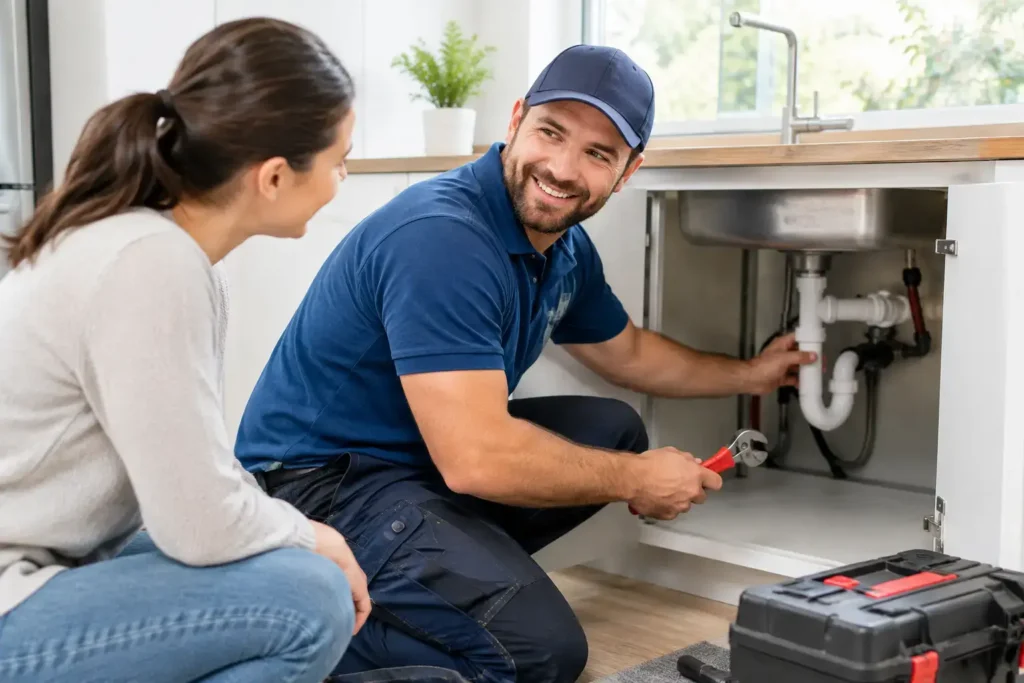
A photo of you or your crew at work usually builds more trust than a generic stock image. Customers want to see the person who may turn up at their door, not a shiny wrench on a white background.
Put your main plumbing services front and centre
A customer with a blocked drain does not want to hunt through menus to confirm you handle blocked drains. Your homepage should quickly point people to the services that bring in the work you want.
For most plumbing businesses, this section will cover jobs such as blocked drains, leaking taps and toilets, hot water repairs and replacements, burst pipes, gas fitting, bathroom plumbing, and general maintenance. Keep each service description short and practical. Explain the problem you fix and what the customer can expect.
For example, a blocked drain service can say that you locate the cause, clear the blockage and help prevent it coming back. A hot water section can explain that you repair faults where possible and provide replacement options when a unit has reached the end of its life.
Do not try to list every small task you have ever completed. Too many choices make the page feel cluttered. Focus on the services that are profitable, common in your area and suited to the kind of jobs you want more of.
Separate urgent jobs from planned work
It can help to make urgent repairs distinct from renovation or maintenance services. A homeowner with water pouring through a ceiling needs a phone number now. Someone planning a bathroom renovation may be happy to send photos and request a quote.
The call to action should match the job. Use Call for urgent plumbing help for time-sensitive work and Get a quote for planned projects. That small change makes the next step clearer and helps you receive better enquiries.
Show the areas you actually service
Local customers want a plumber nearby. A service area section reassures them that you cover their suburb without making them ring just to ask.
Write this naturally. For a Perth plumber, that might mean stating you service Perth, the Perth Hills and selected nearby suburbs. If you regularly work around Midland, Mundaring, Gidgegannup or Sawyers Valley, include those locations where they are relevant to your business.
Avoid dumping a massive list of suburbs into the middle of the homepage. It is hard to read and looks like it was written for search engines rather than customers. A brief service area section, supported by dedicated suburb pages where needed, is usually the cleaner option.
Add proof before asking people to trust you
Plumbing work happens inside people’s homes and businesses. Customers are letting someone near their water, gas, walls and fixtures. Trust is not a nice extra on a plumbing website. It is what gets the call.
A strong proof section can include your licence details where appropriate, years in the trade, insurance, memberships, manufacturer accreditations, and a clear note that you clean up after the job. Use only claims you can stand behind.
Google reviews deserve a spot here too. A handful of specific comments about arriving on time, explaining the problem properly, being tidy and fixing it first go can do more than a page of self-praise. Use real reviews, keep them current and do not edit them into something they are not.
If you work with property managers, strata sites or local businesses, mention it. This helps commercial customers see that you understand their needs, while still showing homeowners you are equipped for everyday repairs.
Use real job photos to prove the quality of your work
Before-and-after photos are useful because they show a result, not just a claim. They are particularly effective for bathroom plumbing, drainage repairs, hot water replacements and visible leak damage repairs.
Keep the images clean and relevant. A few good photos with short captions are better than a gallery full of blurry pictures. Where privacy is involved, avoid displaying customer addresses, personal items or anything that identifies the household.
Photos also help smaller plumbing businesses compete with larger operators. They show there is a real local team behind the number and that you do this work every day.
Explain why customers should choose you, without the waffle
Every plumber says quality service. That phrase means very little unless you explain what it looks like on the job.
Instead, turn your real strengths into practical reasons to choose your business. You might offer upfront communication before work starts, punctual appointments, tidy work areas, clear repair options, or a person who answers the phone rather than an unanswered voicemail.
This section should be short. Three or four direct points are enough if they are meaningful. The goal is not to sound bigger than you are. It is to remove the doubts that stop someone from booking.
Include a simple quote or contact section
Do not make customers scroll back to the top when they are ready to get in touch. Near the bottom of the homepage, repeat your phone number and include a short contact form.
Ask only for what you need: name, mobile number, suburb, a quick description of the issue and, if useful, a photo upload. Long forms lose leads, especially when someone is standing in a puddle under the kitchen sink.
Set expectations as well. A line such as We will get back to you as soon as possible during business hours is better than leaving people guessing. If your business takes calls directly, make that clear. It is a simple trust signal that matters to time-poor customers.
Do not forget the details that cost calls
The best homepage sections for plumbers will not work properly if the basics are missing. Your phone number needs to be clickable on a mobile. Buttons need enough contrast to stand out. The page needs to load quickly, and the content must be easy to scan on a small screen.
Check that every call to action leads somewhere useful. A Call Now button should call. A quote button should open a short form. It sounds obvious, but broken buttons, outdated service areas and old phone numbers quietly cost businesses work every week.
Your homepage does not need to explain every part of your business. It needs to give the right customer confidence to contact you. Build it around the questions they ask before they call, keep it honest, and make getting help the easiest thing on the page. If your current site looks fine but is not generating enquiries, Yazoogle can help identify what is getting in the way and fix the parts that matter.