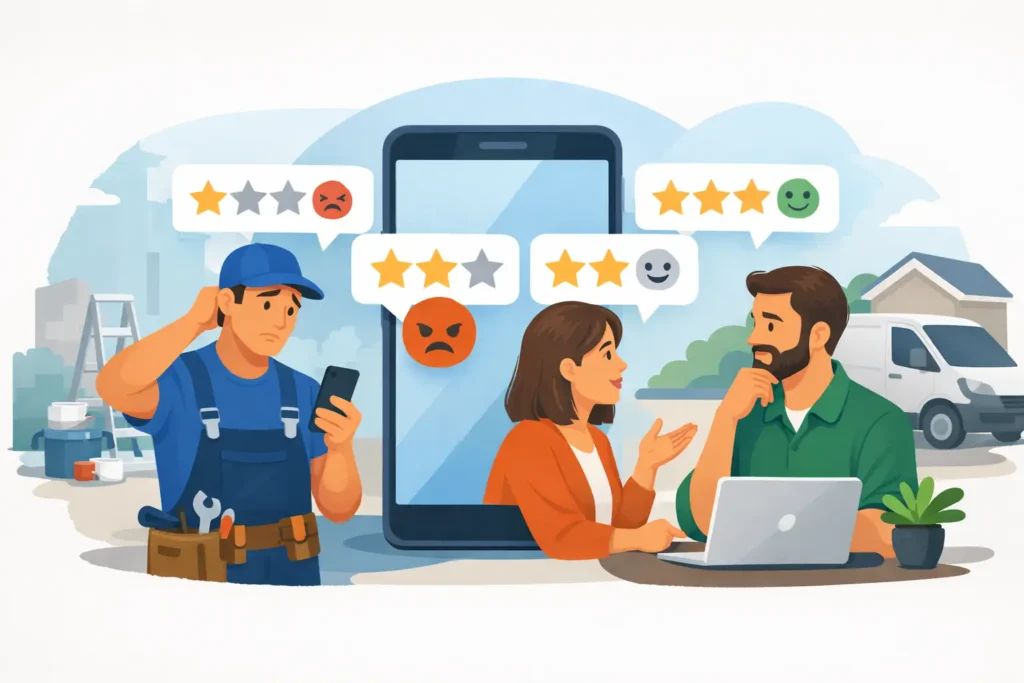
One rough review can feel like a punch in the guts, especially when you’ve done the job, sent the invoice, and moved on thinking the customer was happy. Then you check your Google Business Profile and there it is – one star, a cranky comment, and that sinking feeling that future customers will see it first.
The good news is this: bad Google reviews help more than most tradies realise, if you handle them properly. A business with only perfect five-star reviews can actually look a bit too polished. Real customers know things go wrong sometimes. What they want to see is how you deal with it when they do.
Why bad Google reviews help build trust
Most people don’t expect perfection. They expect honesty, consistency, and a business that answers the phone and fixes problems fast. When someone looks up a plumber, sparky, builder, or landscaper on Google, they’re not only checking your star rating. They’re checking whether you sound reliable.
A bad review gives you a chance to prove that in public.
If you reply calmly, explain the situation without getting defensive, and show that you tried to sort it out, that says a lot. It tells future customers you’re not dodging issues. It tells them you’re a real local business run by real people, not a faceless listing with a logo and a few stock photos.
There’s also a practical side to it. A profile with a mix of reviews often feels more believable than one with 47 glowing reviews and not a single complaint. People are sceptical. They’ve seen fake reviews before. A handful of less-than-perfect reviews can make the good ones carry more weight.
When bad Google reviews help – and when they don’t
Not every bad review is useful. Some reviews are unfair, misleading, or posted by someone who was never even a customer. Others point out genuine issues that need fixing.
That distinction matters.
If the review is fake, abusive, or clearly against Google’s rules, you should report it. Don’t just leave rubbish sitting there if it’s doing damage and shouldn’t be there in the first place.
If the review is real, even if it’s annoying or exaggerated, there’s usually something to work with. Maybe the customer was frustrated by delays. Maybe there was a communication breakdown. Maybe no one followed up after the quote. Those issues can hurt enquiries just as much as the review itself.
So yes, bad reviews can help, but only when you use them as feedback and respond like a professional. If you ignore them, argue with them, or let a pattern build up, they stop being helpful pretty quickly.
What customers actually think when they read a bad review
Tradies often assume a bad review sends everyone running. That’s not usually how it works.
Most people read more than one review before making a call. They look for patterns. If one person says you were late, but ten others say you were reliable and did quality work, that single review won’t carry much weight. If three or four people all mention poor communication, missed appointments, or not turning up, then people start to pay attention.
That’s why your response matters so much.
A solid response can soften the impact of a bad review and sometimes even turn it into a trust signal. It shows you’re active, switched on, and willing to deal with problems. Silence can look like you don’t care. An angry reply can look even worse than the original review.
Customers are not expecting you to win every argument. They’re looking for signs that you’ll be reasonable to deal with if something goes wrong on their job.
The wrong way to respond
You’ve probably seen it before – the business owner fires back, calls the reviewer a liar, and starts arguing in public. Even if the owner is technically right, it looks messy.
The same goes for copy-and-paste responses that sound robotic. If every reply says, “We value your feedback and strive to improve our customer experience,” it doesn’t sound genuine. It sounds like no one could be bothered.
The better way to respond
Keep it short, polite, and clear. Acknowledge the issue. If the customer is genuine, offer to sort it out offline. If the facts are wrong, calmly correct them without turning it into a scrap.
Something as simple as this can work well:
“Sorry to hear this was your experience. We always aim to communicate clearly and complete work on time. We’ve looked into your job and would be happy to discuss it directly to see if we can sort things out.”
That’s enough. You’re not trying to impress the person who left the review. You’re speaking to the next person who reads it.
Bad reviews can improve your business if you pay attention
A lot of review problems are really process problems.
If customers keep mentioning that quotes took too long, your quoting system may be the issue. If they say no one got back to them, there may be a gap between missed calls, contact forms, and follow-up. If they complain about confusion around scope, maybe the job wasn’t explained properly before work started.
This is where bad Google reviews help in a very practical way. They highlight the weak spots that cost you work.
You don’t need to overthink it. Look at what people are saying and ask yourself whether the same issue keeps coming up. If it does, fix the process behind it. Better communication, faster responses, clearer expectations, and cleaner follow-up often solve more reputation problems than fancy marketing ever will.
A few bad reviews won’t sink your rankings
Tradies often worry that one or two poor reviews will wreck their visibility on Google. Usually, that’s not the case.
Google looks at the bigger picture. Review quantity, review recency, your overall rating, profile activity, and how complete your Google Business Profile is all play a part. One negative review among a healthy flow of positive ones is rarely the thing that tanks performance.
What causes more damage is neglect.
If your profile hasn’t been updated in months, you’re not asking for new reviews, and the last few comments are negative with no reply, that sends a poor signal to both Google and potential customers. On the other hand, if you keep generating fresh reviews and responding properly, the odd bad one gets buried by stronger signals.
That’s one reason review management matters. It’s not about chasing perfection. It’s about showing that your business is active, trusted, and still doing solid work.
How to make bad reviews work in your favour
The best move is not to panic. Read the review properly, wait until the initial frustration passes, and decide what action makes sense.
If it’s a real complaint, respond quickly and professionally. Then look at whether the issue can be resolved offline. Sometimes a quick call sorts things out. Sometimes the customer updates the review. Sometimes they don’t. Either way, future customers will see that you handled it properly.
At the same time, keep asking happy customers for reviews. This is where many tradies fall over. They get one bad review, focus on it for weeks, and forget the simple fix – get more good reviews from real clients. A steady stream of recent, genuine feedback makes your profile stronger and gives people a fairer picture of your business.
If you’re flat out on the tools, this part often gets missed. But it matters. Review requests need to be part of the job process, not something you remember once every few months.
The real issue is rarely the bad review itself
Most of the time, a bad review is only a big problem when the rest of your online presence is weak.
If your website is outdated, your Google Business Profile is half-finished, your service areas are unclear, and your reviews are thin on the ground, then yes, one harsh review can do more damage. It lands on top of an already shaky setup.
But if your online presence is solid, your reviews are active, and your business looks legitimate from the first click, a bad review becomes one small part of a much bigger picture.
That’s the difference.
For local service businesses, trust is built across everything people see online – your reviews, your website, your photos, your service info, and how easy it is to contact you. If all of that stacks up, one unhappy customer won’t define your business.
And if you need help tightening up that whole picture, that’s exactly the sort of practical work Yazoogle helps tradies with.
A bad review isn’t always the disaster it feels like on the day. Sometimes it’s the thing that pushes you to fix a weak process, respond better, and build a stronger reputation that wins more work over time.