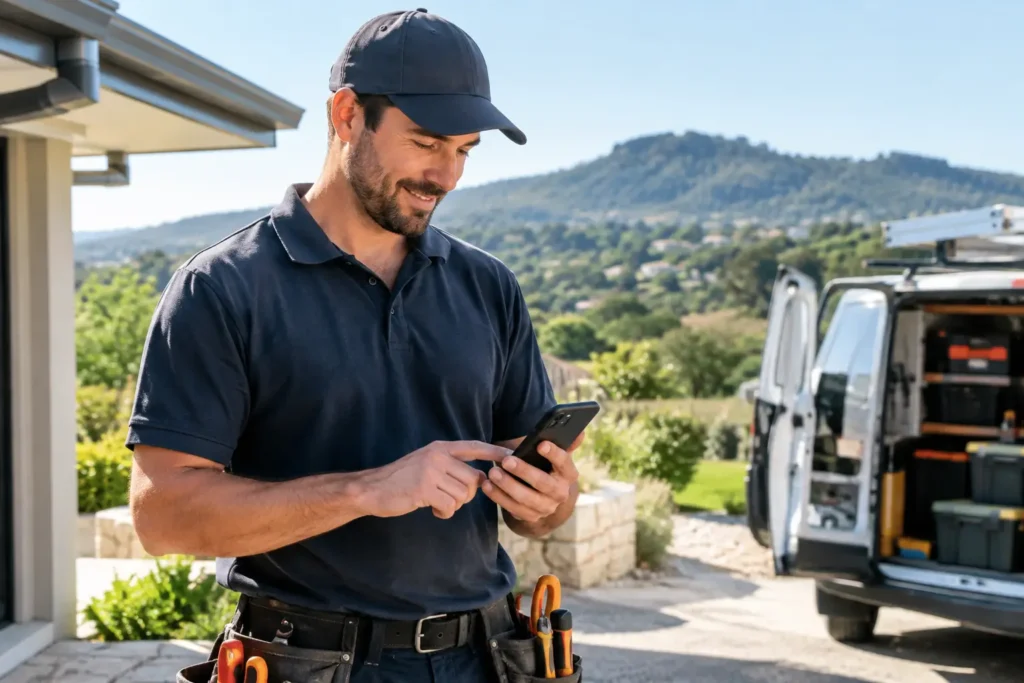
A homeowner in Mundaring with a burst pipe or a faulty switchboard is not spending half an hour comparing websites. They are searching on their mobile, checking who looks local and reliable, then calling the business that makes it easy. This Perth Hills tradie website guide covers what your website needs to do to win that call.
For a plumber, electrician, builder, landscaper or painter, a website is not an online brochure. It should be a practical lead tool that explains what you do, proves you are the right person for the job and gives people a clear way to contact you. If it is slow, confusing or hard to use on a mobile, it can quietly send good jobs to someone else.
What a Perth Hills tradie website must achieve
Your website has one main job: turn local searches into enquiries. That does not mean filling every page with marketing talk. It means giving potential customers the answers they need before they pick up the phone.
A good tradie website makes it clear what services you provide, which areas you cover and how customers can get in touch. It should also show that you are a real local business with experience, proper contact details, reviews and examples of completed work.
The Perth Hills has its own mix of work. There are larger blocks, older homes, bushfire-prone areas, rural properties and customers spread across suburbs and small communities. If you handle jobs in places such as Mundaring, Gidgegannup, Sawyers Valley or Midland, say so where it makes sense. Local detail helps customers feel confident you actually work in their area.
Trying to appeal to everyone with a vague message such as “quality services at competitive rates” rarely helps. A customer wants to know whether you fix hot water systems, install switchboards, build retaining walls or maintain large properties. Be specific.
Start with the pages that bring in work
Most small trade businesses do not need a huge website. They need the right pages, written clearly and set up to guide customers towards a call or quote request.
Your home page should quickly answer three questions: what do you do, where do you work and why should someone contact you? Put this information near the top. Do not make visitors hunt through a photo slideshow or click through several pages to find it.
Service pages matter because people often search for a particular job rather than a business name. An electrician may need separate pages for power points, lighting, switchboard upgrades, smoke alarms and fault finding. A landscaper might need pages for paving, retaining walls, garden clean-ups and irrigation. These pages give Google and customers a better understanding of your work.
You do not need a page for every tiny variation of every job. Thin pages with a few repeated lines will not build trust. Focus on the services that are profitable, regularly requested and worth travelling for.
A contact page should be simple. Include your phone number, email address, service area and a short form that asks only for useful details. Name, suburb, phone number and a brief description of the job are usually enough. Long forms lose people, especially when they are standing in a driveway or dealing with an urgent problem.
Make calling you the easiest option
Tradie websites often lose leads for a basic reason: the phone number is hard to find. On a mobile, it should be visible straight away and clickable. A clear “Call now” button is not pushy when someone is actively looking for help. It is useful.
Quote forms still have a place, particularly for larger building, landscaping or renovation work. Give customers both options. Some people want to call immediately, while others are checking options after hours and prefer to send a request.
Set expectations honestly. If you offer emergency work, say when and how customers can reach you. If you are usually on the tools and cannot always answer straight away, let people know you will return calls promptly. Then follow through. A good website can generate the enquiry, but answering the phone and responding quickly is what turns it into a job.
Avoid clutter around your call to action. Too many buttons, pop-ups and competing messages make a website feel messy. One clear next step per section is normally enough: call for urgent help, request a quote for planned work, or send photos for an assessment where that suits your trade.
Use proof, not promises
Anyone can call themselves reliable. Customers are more likely to believe you when they see proof.
Start with genuine reviews. A handful of recent, detailed reviews can be more persuasive than a page full of broad claims. They show potential customers how you communicate, turn up and leave the job. Make it part of your process to ask happy customers for a review once the work is complete.
Photos are equally valuable, especially for builders, landscapers, painters and other visual trades. Use real project photos where possible. Before-and-after shots, completed bathrooms, retaining walls, gardens or neat switchboard work show the standard you deliver. Clear images from a mobile are fine if they are well lit and show the job properly.
Include licences, qualifications, insurance details or relevant memberships where appropriate. Do not overload the page with logos, but give customers the reassurance they need before inviting someone onto their property.
Case studies can help with bigger jobs. Keep them practical: explain the customer’s problem, the work completed and the result. A short project example is more useful than a long sales pitch.
Get the local basics right
A website works best alongside an accurate Google Business Profile. Your business name, phone number, service area and opening hours should match across both. If a customer finds one phone number on Google and another on your website, it creates doubt.
Use your business address only if customers can genuinely visit you there. Many tradies are service-area businesses, and that is fine. The key is to clearly state the suburbs and areas you serve without cramming a long suburb list into every paragraph.
Each main service page should include natural references to Perth or the Perth Hills where relevant. For example, a page about split-system air conditioning could mention installations and repairs for Perth Hills homes. The wording must still read like it was written for people, not search engines.
Keep your details current. If you change your phone number, add a new service, take on a wider area or stop offering emergency call-outs, update the website and Google profile straight away. Outdated information costs enquiries and wastes your time with unsuitable calls.
Mobile speed is not a minor detail
Most local trade searches happen on a mobile. A customer could be in the kitchen, at a worksite or sitting in a parked car when they look you up. If your site takes too long to load, has tiny text or forces them to zoom in, they will move on.
Keep pages focused and photos compressed properly so they load quickly without looking poor. Use readable text, decent spacing and buttons that are easy to tap with a thumb. Test your own website on your mobile. Can you find your number, services and quote form in under a minute? If not, neither can a potential customer.
Flashy animations and oversized video backgrounds might look impressive on a desktop screen, but they can slow down the page and get in the way. For a local service business, clear information and fast contact options matter more than fancy effects.
Common website problems that cost tradies leads
An old site is not automatically a bad site, but it needs to earn its place. If it does not generate calls, there is usually a practical reason to fix.
Common problems include a home page that never clearly says what the business does, generic stock photos instead of real work, no visible service areas, weak or missing reviews, and contact forms that go nowhere. Another common issue is trying to send every visitor to a single general services page. Someone searching for a specific electrical repair or retaining wall job wants relevant information fast.
There is also a trade-off with detail. A two-page site may be easy to manage, but it can struggle to show the full range of services you want to rank for. On the other hand, a large site with dozens of neglected pages can look stale. Build the important pages first, then add useful content as your business grows.
Treat your website like part of the job pipeline
Your website should be checked regularly, just like your tools, vehicle and job schedule. Look at the enquiries coming through. Are people asking for the jobs you want? Are they calling from the areas you service? Are quote requests being answered quickly?
If you are getting traffic but no calls, the issue may be the message, the mobile layout or the lack of proof. If you are barely being found, local SEO and your Google Business Profile may need attention. There is no point guessing when a practical review can show where enquiries are being lost.
Yazoogle helps Perth tradies build websites that are clear, local and designed to generate real enquiries, without burying you in jargon. The best first step is simple: look at your website through a customer’s eyes, then fix the one thing making it harder for them to call you today.