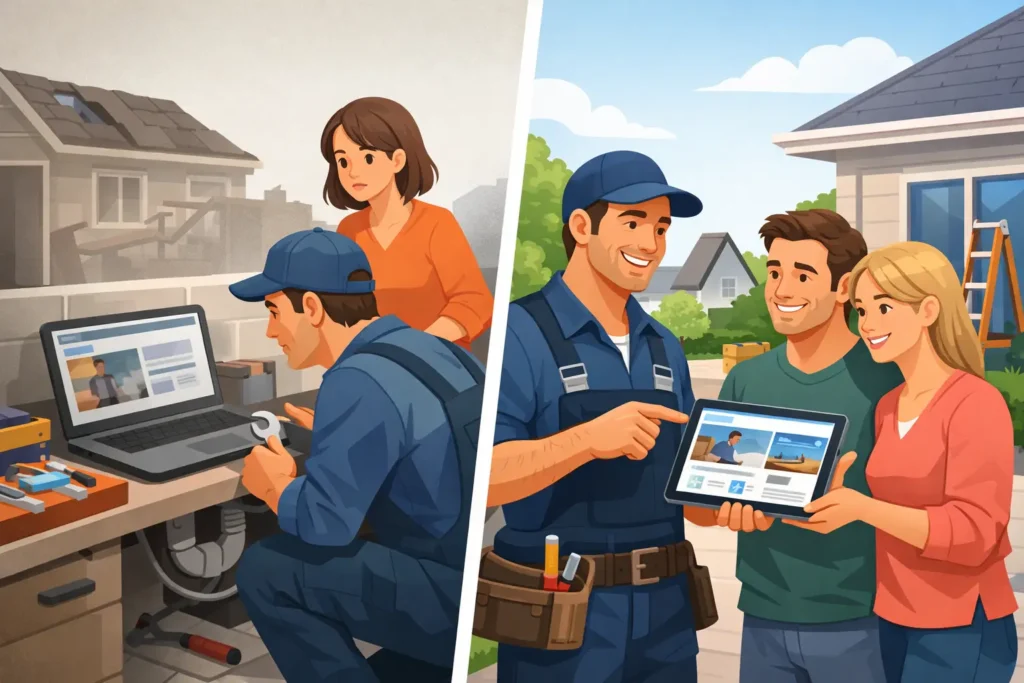
A bad website usually doesn’t fail in one obvious way. It leaks work through a dozen small problems – slow load times, weak service pages, no trust signals, clunky mobile layout, and no clear next step. That’s why a tradie website before after comparison matters. It shows what changes when a site stops being just an online placeholder and starts pulling its weight.
If you’re a plumber, sparky, builder or landscaper, you don’t need a flashy site. You need one that gets found on Google, looks trustworthy fast, and makes it easy for people to call, message, or request a quote. That’s the difference between a site that sits there and one that brings in work.
What a tradie website looks like before
Most underperforming tradie websites have the same pattern. They were either built years ago, thrown together quickly, or designed to look decent without much thought about enquiries.
The homepage often tries to say everything at once and ends up saying nothing clearly. You land on the site and can’t tell within a few seconds what suburbs are serviced, what jobs are taken on, or why this business is the right one to call. For a local customer who needs help now, that’s enough reason to leave.
Then there’s mobile. A lot of tradie traffic comes from people on their phone, often while standing in a driveway, at a job site, or dealing with an urgent problem at home. If the phone number is hard to tap, the text is cramped, or the contact form feels like hard work, enquiries drop off quickly.
Trust is another big issue. Before the rebuild, many sites have poor-quality photos, outdated branding, thin service pages, and no real proof of work. No recent reviews. No clear service area. No signs that the business is active and reliable. Even if the business itself is solid, the website can make it look half switched off.
The real tradie website before after difference
When people think about a website upgrade, they often picture a visual makeover. Better colours, cleaner layout, sharper photos. That helps, but the real win is what changes underneath the surface and how that affects leads.
A strong after version is clearer from the first screen. It tells people what you do, where you work, and how to get in touch. It gives them confidence without making them dig around. Good websites reduce hesitation. That matters because most customers don’t compare ten businesses in detail. They shortlist fast and contact the one that feels easiest to trust.
The structure is usually the biggest shift. Instead of one general page trying to cover every service, the site has focused pages for each core job. That helps both users and Google. Someone searching for blocked drains, switchboard upgrades, retaining walls or lawn reticulation wants a page that speaks directly to that job, not a vague list hidden halfway down the homepage.
There’s also a clear path to action. That could be a prominent call button, a short quote form, or strong contact prompts placed in the right spots. The point is simple – if someone is ready to make contact, the website shouldn’t slow them down.
What changes on the page
A proper before and after isn’t just about making the site prettier. It’s about making every section do a job.
Clearer messaging
Before, the headline might be generic and easy to ignore. After, it spells out the service and location in plain English. That matters for both local search and human attention. Customers should know straight away whether you’re the right fit.
Better service pages
Thin pages get replaced with useful ones. Each page explains the type of work, common problems, what customers can expect, and how to book. This helps rankings, but more importantly it helps conversions. People feel more comfortable making contact when the page sounds like it understands their problem.
Stronger trust signals
Reviews, photos of actual work, suburb coverage, licence details where relevant, and straightforward contact info all help. None of this is fancy, but it works. Trust online is built by removing doubt.
Faster mobile experience
The after version usually loads faster, reads better on a mobile, and puts the phone number where people can actually use it. For tradies, this can make a bigger difference than any design trend.
Why the before after result shows up in leads
A lot of business owners assume low enquiries mean low demand. Sometimes that’s true, but often the issue is friction. Your website might be getting visits, but not turning them into calls.
A better site fixes that by matching how people search and choose. Local customers usually want quick answers. Do you service my area? Do you handle this kind of job? Can I trust you? How do I contact you now? If the site answers those four questions quickly, you’re already ahead of plenty of competitors.
Google also responds better when the site is organised properly. Clear page structure, relevant local content, proper headings, and useful service information all improve your chances of showing up for the right searches. That doesn’t mean results happen overnight. It does mean the website starts supporting visibility instead of holding it back.
Tradie website before after and local SEO
This is where the gap gets even wider. A before site often has almost no local SEO foundation. It might mention the business name and phone number, but that’s about it. There’s no real suburb targeting, no well-written service pages, and no consistency between the website and your Google Business Profile.
The after version is built to support local search from the start. That means pages are written around real services and real locations, not stuffed with awkward keywords. It means the business details are easy to verify. It means the website gives Google stronger signals about what you do and where you do it.
For a tradie in Perth or the Perth Hills, that matters because most of the jobs you want come from nearby searches. You’re not trying to impress the whole country. You’re trying to show up when someone local needs the work done and wants to call the right person first.
Not every website rebuild gets the same outcome
This part matters. A redesign alone won’t fix everything.
If the business has poor reviews, answers the phone inconsistently, or takes too long to follow up leads, the website can only do so much. It can improve visibility, build trust, and increase enquiries, but the rest still depends on how the business handles those enquiries once they come in.
It also depends on the starting point. If your current site is badly outdated, the lift can be noticeable. If it already looks decent but lacks local search support and conversion focus, the gains may show more in lead quality than raw traffic. That’s still a good result if it means better jobs and fewer time-wasters.
What to look for in your own before and after
If you’re judging your current site, don’t just ask whether it looks old. Ask whether it helps someone take action.
Can a customer tell what you do in under five seconds? Can they find the areas you service without hunting for it? Can they tap to call on mobile? Are there pages for the actual jobs you want more of? Does the site feel active and trustworthy, or neglected?
Those are the questions that expose the gap between before and after.
A good tradie website should support the way your business actually runs. It should bring in the kind of work you want, make it easier for locals to contact you, and give people confidence before they even pick up the phone. That’s the standard worth aiming for.
For tradies around Perth, that usually means less fluff and more function. Clear service pages. Better mobile layout. Stronger local signals. Real proof of work. A website that helps you win the job, not just show that you exist.
That’s what a proper before and after should look like. Not just a nicer site, but a more useful one. And if your current website still feels like a brochure from another era, there’s a fair chance it’s costing you work you should already be getting.