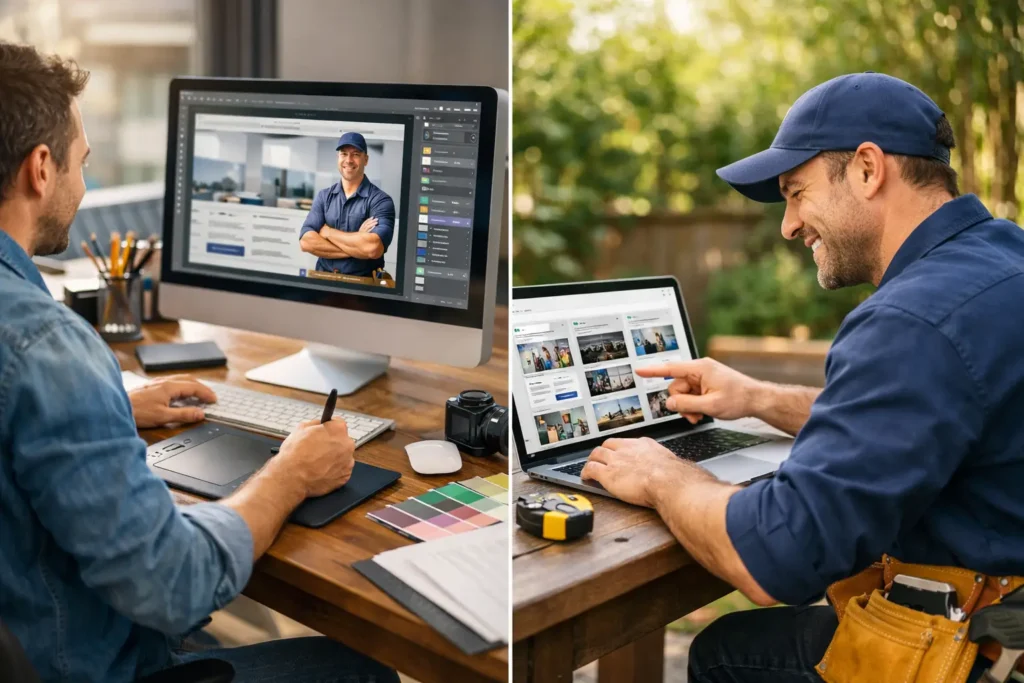
A lot of tradies start with a website builder because it feels quick. Pick a template, add a few photos, write a couple of service pages, and job done. But when you look closely at custom websites vs website builders, the real question is not which one is easier to launch. It is which one is more likely to bring in calls, quote requests, and steady local work.
If your website is only there to tick a box, a builder can do that. If it needs to help your business show up on Google, build trust fast, and turn visitors into enquiries, the decision needs more thought.
Custom websites vs website builders for tradies
For a tradie or local service business, your website has one job. It needs to help the right people find you and make it easy for them to get in touch. That sounds simple, but plenty of websites miss the mark.
A website builder gives you a pre-made system. You choose a layout, swap in your logo, add your text, and publish. It can be a decent starting point if you are brand new, have no existing online presence, and just need something live.
A custom website is built around your business, your services, your service areas, and the way your customers actually search. It is not just about appearance. It is about structure, speed, clear calls to action, and making sure each page has a purpose.
That difference matters when someone in your area needs a plumber, sparky, builder, or landscaper and wants someone local who looks reliable.
What website builders do well
Website builders are popular for a reason. They are simple to use, usually fairly quick to set up, and they let business owners make changes without needing much help. If you want to update a photo, change a heading, or add a new gallery, that can be handy.
They also remove some of the early friction. For a sole trader just getting started, that can feel like a win. You are not waiting weeks for a build. You are not trying to sort through a heap of choices. You can get online and start sharing your web address.
For some businesses, that is enough for a while.
The trouble starts when the site needs to do more than just exist. Most tradies are not chasing a website for the sake of it. They want more quote requests, more calls, and better visibility in the suburbs they service. That is where the limits often show up.
Where website builders often fall short
Templates are built to suit everyone, which usually means they are not ideal for anyone in particular. A builder might look clean on the surface, but the layout may not match how a local service business should present its services.
A tradie website needs clear service pages, local area relevance, trust signals, mobile-friendly contact options, and strong enquiry paths. If someone lands on your site from Google, they should know within seconds what you do, where you work, and how to contact you.
With website builders, it is easy to end up with a site that looks fine but feels generic. You see the same layouts, the same stock-style sections, and the same weak service page setup. That can hurt both your conversion rate and your visibility.
There is also the issue of control. Builders often lock you into their way of doing things. If you want the site to grow with your business, improve the page structure, or fine-tune the layout around what gets results, you may hit a wall.
Why custom websites give growing businesses more room
A custom website starts with the business goal, not the template. For a local service business, that usually means building around enquiries.
That affects everything. The page structure can be planned around your core services and locations. The calls to action can be placed where people are most likely to act. The contact options can be kept obvious, especially on mobile. The content can be written in plain English for real customers, not filled with filler.
A custom build also gives you more freedom to shape the site around how your business operates. Maybe you want separate pages for blocked drains, hot water systems, emergency plumbing, and gas fitting. Maybe you service a mix of Perth metro and Hills suburbs and need that reflected properly. Maybe you want stronger before-and-after proof, review sections, or lead forms that suit the way you quote.
That sort of flexibility is hard to get right in a one-size-fits-all builder.
Google visibility is part of the decision
A lot of tradies judge a website by how it looks. Fair enough. But Google does not rank websites because they have a nice banner image.
If you want to show up for local searches, your website needs the right foundations. That includes clean page structure, relevant service content, proper local signals, and a setup that supports ongoing SEO work.
This is one of the biggest differences in custom websites vs website builders. A builder might let you add page titles and basic text, but that does not mean the overall site is structured well for local search.
A custom website can be built with local SEO in mind from the start. That means your service pages are not buried, your location relevance is clear, and your content supports the way local customers search. For a tradie, that can have a direct effect on how many enquiries come through over time.
It is not magic, and no website alone guarantees rankings. But the right setup gives you a much better base to work from.
The mobile experience matters more than most think
Most local customers are searching on their mobile. They are often in a hurry, comparing a couple of businesses, and looking for someone who seems reliable and easy to contact.
If your site is clunky on mobile, slow to load, hard to read, or makes people hunt for your phone number, you will lose work. That is true whether the website was built on a builder or custom.
The difference is that a custom site can be shaped around how your customers actually behave. Big click-to-call buttons, fast access to service info, strong review placement, and fewer distractions all help. On a builder, you can sometimes get close, but you are still working within the limits of the template.
For a tradie website, simple usually wins. Not plain and forgettable. Just easy to use, fast to understand, and built to get the enquiry.
When a website builder might still be the right call
There are cases where a website builder makes sense. If you are just starting out, have almost no budget or time, and need a basic online presence this week, it can be a practical short-term option.
It can also work if most of your leads come from word of mouth and your website is only there so people can quickly check that you are legit. In that case, a clean one-page or small brochure-style site may do enough for now.
But it helps to be honest about the trade-off. A quick site is not the same as a high-performing site. If your goal is stronger Google visibility and better conversion from local traffic, a builder may become the thing you outgrow.
When custom is usually the better investment
If your current website is not bringing in enquiries, if you want to rank better in your local area, or if you are relying too heavily on referrals and want more consistent leads, custom is usually the stronger path.
The same goes for businesses with multiple services, multiple service areas, or a need to stand out in a crowded market. A proper custom website gives you more room to position the business clearly and build trust quickly.
That does not mean overcomplicating it. The best tradie websites are often the simplest to use. They just happen to be simple on purpose.
That is where working with someone who understands local service businesses matters. A site for a plumber in Midland or an electrician in Mundaring should not be built like a generic business template. It should be built around what local customers want to see before they call.
So which one gets more jobs?
If the question is custom websites vs website builders, the honest answer is that both can get a site online. Only one is more likely to be shaped around getting results.
A website builder can be fine for a basic presence. A custom website is usually the better option if you want your website to do real work for the business.
That means more than looking professional. It means showing up better, making a stronger first impression, and giving people a clear reason to contact you instead of the next tradie on the list.
If your website is meant to help fill the diary, not just sit there, build it with that job in mind from day one.