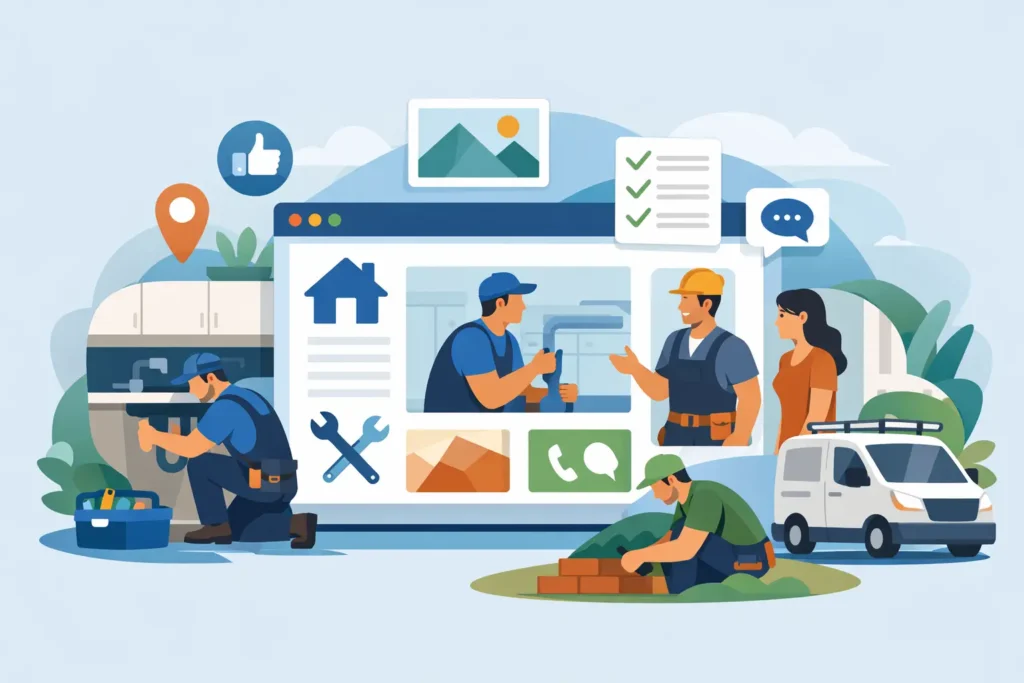
A lot of tradie websites lose the job in the first five seconds. The customer lands on the homepage, can’t quickly tell what you do, where you work, or how to contact you, and they hit back. If you want the best homepage elements for tradies, start with the stuff that gets people to call, enquire, and trust you fast.
Your homepage is not there to impress other web designers. It is there to help a busy homeowner or property manager make a quick decision. Can you do the job? Do you work in their area? Can they contact you without mucking around? If the answer is not obvious straight away, your homepage is costing you work.
What a tradie homepage actually needs to do
Most people visiting a tradie website are not browsing for fun. They have a blocked drain, a faulty switchboard, a leaking roof, or a garden that needs sorting before the weekend. They want a clear answer, a reliable business, and a simple next step.
That means your homepage has three jobs. It needs to explain what you do, prove you are trustworthy, and make it easy to contact you. Everything else is secondary.
Plenty of websites get this backwards. They lead with vague slogans, oversized stock photos, or paragraphs that say a lot without saying much. A strong tradie homepage is simpler than that. It is built around action.
The best homepage elements for tradies
A clear headline that says what you do and where
Your main headline should be plain English. If you are a plumber in Perth, say that. If you are an electrician servicing the Perth Hills, say that. The customer should not need to scroll or guess.
A good headline is specific. “Reliable plumbing services in Perth” is far better than “Quality solutions you can trust”. The second line can add more detail, such as emergency callouts, residential work, or same-day service. This is one of the most important homepage elements because it reduces confusion straight away.
A strong call to action above the fold
When someone lands on your homepage, the next step should be obvious. Call now, request a quote, book a job, or send an enquiry. Pick one main action and make it stand out.
Some businesses try to offer too many options at once. That can work if done neatly, but often it just creates clutter. For most tradies, a phone button and a quote form button are enough. If you answer the phone quickly, lean into calls. If you quote after hours, give people a simple enquiry option too.
Your phone number in a visible spot
This sounds basic, but a lot of tradie websites still hide the phone number in a menu or only place it on the contact page. Put it in the header and keep it visible on mobile. If someone has to hunt for your number, you are making them work too hard.
For urgent services, this matters even more. A homeowner with a burst pipe is not filling out a long form if another plumber’s number is right there.
Service areas that are easy to spot
Customers want to know if you work in their suburb. Google wants that clarity too. Your homepage should mention the key areas you service in a natural way.
You do not need to stuff in every suburb in WA. A short line that says you service Perth, the Perth Hills, and nearby areas is usually enough on the homepage, with more detailed area pages elsewhere if needed. The goal is clarity, not a wall of location names.
Real trust signals
Trust is a big part of getting enquiries, especially for higher-value jobs. People are inviting you onto their property, often based on what they see online. Your homepage should help them feel comfortable making contact.
That means using real reviews, licence details where relevant, years of experience, and genuine photos of your work or team. If you are insured, say so. If you offer emergency response, say so. If you are known for turning up on time and cleaning up after the job, say that too.
Specific trust signals work better than generic claims. “5-star reviews from local customers” is stronger when backed by actual review snippets. “Family-owned and operated” can help if it is true, but it is not enough on its own.
Photos that look like your business
One of the best homepage elements for tradies is also one of the most overlooked – real imagery. If your homepage is full of stock photos of smiling models in spotless uniforms, it can feel fake fast.
Use photos of your team, your ute, your jobs, your tools, and the kind of work you actually do. The images do not need to be fancy. They do need to feel genuine. For a local business, real beats polished if polished looks staged.
There is a trade-off here. You still want the site to look professional. Dark, blurry, messy photos can hurt trust. So the sweet spot is authentic but clean.
A short services section
Do not make people dig through menus to work out whether you handle their job. Your homepage should include a simple section covering your main services.
For example, a sparkie might list power points, lighting, switchboards, smoke alarms, fault finding, and emergency electrical work. A landscaper might show paving, retaining walls, turf, irrigation, and garden clean-ups. Keep it brief, but make it useful.
This section helps both customers and search visibility. More importantly, it reassures the visitor that you handle the kind of work they need done.
Proof of recent work
Photos of completed jobs, before-and-after examples, or a small project gallery can do a lot of heavy lifting. People want proof that you can actually deliver the result.
This matters most for visual trades like landscaping, painting, roofing, tiling, and building, but it still helps other services too. Even a plumber can show neat finished work, bathroom fit-offs, hot water system installs, or commercial maintenance jobs.
Keep it relevant. Ten strong examples beat fifty random images.
A contact form that does not ask too much
Long forms lose leads. If your homepage form asks for every detail under the sun, many people will give up halfway through.
Name, phone, suburb, and a short message is usually enough to start. You can gather more detail later. If you want better-quality leads, add one useful field like “What do you need help with?” but keep the barrier low.
This is where a lot of websites get in their own way. They try to qualify every lead before the first conversation. For local service businesses, speed usually wins.
What to leave off the homepage
A homepage can be damaged just as much by what is included as what is missing. Too much text, too many pop-ups, autoplay videos, confusing menus, and generic slogans all slow people down.
The same goes for trying to say everything at once. If you do residential, commercial, maintenance, emergency, insurance, renovations, and strata work, that is fine. Just organise it clearly. A cluttered homepage makes a business look harder to deal with.
Fancy effects are rarely what gets more calls. Clear information, quick loading, and an easy path to contact usually do more for results.
Homepage content needs to work on mobile first
Most tradie website visitors are on their mobile. They are standing in the kitchen with a leak, out the front looking at a dead air con unit, or on-site trying to organise another contractor. If your homepage is hard to use on mobile, that is a real problem.
Buttons need to be tappable. Text needs to be easy to read. Important sections should appear early. And your phone number should be one tap away. A desktop site that looks great but performs poorly on mobile is not doing the job.
This is also where speed matters. Heavy images, messy layouts, and overbuilt pages can slow the site down. People are impatient. If the homepage drags, they move on.
Good homepage design is really about reducing hesitation
The best tradie homepages do not try to be clever. They remove doubt. They answer the quiet questions people have before they contact you.
Do you do this type of work? Are you local? Can I trust you? Will you answer the phone? Can I contact you quickly?
If your homepage answers those questions without making people think too hard, it is doing what it should. That is where more enquiries come from.
A lot of tradies do not need a bigger website. They need a better homepage. One that speaks clearly, shows proof, and gives people a simple reason to get in touch. If your current site is not doing that, it is worth fixing – because the right homepage does not just look better, it helps keep the phone ringing.