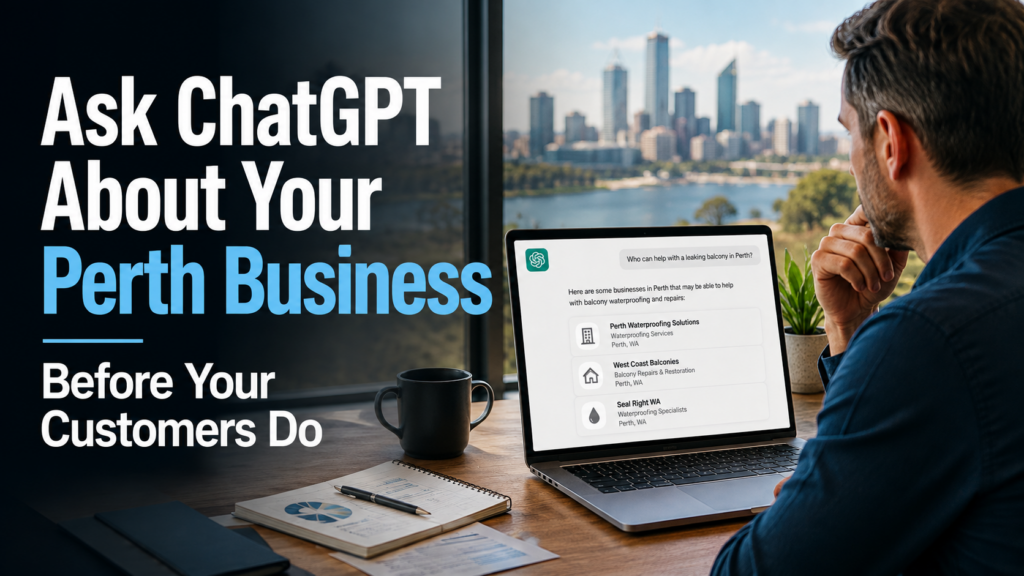
A potential customer who wants a plumber, accountant, landscaper, commercial painter or web designer in Perth no longer has to begin with Google. They can open ChatGPT or another AI assistant and describe the situation in ordinary language: who can fix this, which type of business should I call, what should I look for, who operates near me, or which providers appear to specialise in this problem? The customer may never type your business name at all. They are asking the AI to help create the shortlist. A simple ChatGPT business test can reveal what AI understands about your company before a potential customer asks.
That changes the value of a simple exercise most Perth business owners have never performed: asking AI what it thinks their business actually is. Not asking it to write a Facebook post for the business, summarise supplied information or improve some website copy, but approaching it as a stranger would. What does it believe you do? Where does it think you operate? Which problems does it associate with you? What appears important about the business, and what has failed to make the journey into the answer?
This is not a test of whether ChatGPT can recite your About page. It is a test of whether the identity you have built across the web is clear enough to survive interpretation. An AI-generated answer may be incomplete, inconsistent or occasionally wrong, but those weaknesses can still be useful. They can expose the difference between what a business owner knows to be true about the company and what an outsider can reasonably discover and understand.
The useful question, therefore, is not simply, “Does AI know my business?” It is: If a potential customer relied on AI to understand my business, what picture would they receive?
Searching for Your Name Is the Easiest Test, but Not the Most Important One
Begin with the obvious question. Open ChatGPT and ask something such as, “What can you tell me about [business name] in Perth?” Keep the wording neutral. Don’t explain the company first, don’t paste the website and don’t correct the AI before it answers. You are trying to see what picture emerges without your assistance.
Read the response as a prospective customer rather than as the owner. Business owners have enormous amounts of background knowledge, so they automatically fill in gaps that a stranger would notice. If the answer says you provide “building services”, you may know exactly which building services those are. A customer may not. If it describes you as serving “Western Australia”, you may understand that most work is actually concentrated in Perth. If it identifies one service but overlooks another important part of the business, the missing service matters even though everything stated is technically correct.
Accuracy is only the first layer. A completely factual description can still be commercially weak. Imagine a Perth air-conditioning company whose AI description says it “provides air-conditioning services to residential and commercial customers.” There may be nothing false in that sentence, yet it doesn’t tell a homeowner with a bedroom that never cools properly, a noisy split system or an ageing unit that has suddenly stopped working whether this is the company to consider. The AI recognises the category, but not necessarily the situations that make someone need the business.
This produces the first useful distinction: recognition is not understanding. AI recognising your name, industry and location is encouraging, but the more valuable test is whether it understands what makes your business relevant to a particular customer problem.
Ask the Questions Your Customers Would Ask
The strongest test removes your business name completely. Instead of asking about yourself, ask the kind of question a customer might ask before they know you exist. This changes the exercise from a brand lookup into a relevance test.
A Perth pool owner, for example, is unlikely to begin with the name of a coating manufacturer they have never heard of. They might ask, “What kind of paint should I use to repaint a concrete swimming pool in Perth?” Someone with a leaking balcony might ask what type of contractor handles waterproofing failures. A business owner concerned about an outdated website might ask who in Perth can rebuild a small-business website without turning the project into an expensive corporate exercise. These questions reveal which businesses, service types, explanations and decision criteria AI connects with the problem itself.
You don’t need dozens of elaborate prompts. A small set of customer-style questions can expose a surprising amount:
- “What type of business should I contact in Perth for [specific problem]?”
- “Who in Perth specialises in [specific service or situation]?”
- “What should I look for when choosing a Perth business for [job]?”
- “Which Perth businesses appear to help with [specific problem]?”
- “I have [recognisable situation]. What kind of local business can help?”
The wording matters because customers rarely describe themselves using your internal service categories. A roofing company may think in terms of roof restoration, membrane coatings and repointing. The homeowner may think, “My tiled roof looks terrible and water is appearing near the ceiling.” A digital agency may think in terms of local SEO, conversion optimisation and AI visibility. The business owner may think, “When I ask ChatGPT for businesses like mine, my competitors appear and I don’t.”
This is where the exercise becomes more revealing than searching for your own name. You are testing whether the problems customers recognise are connected with the services you sell. If that connection is weak online, AI may understand each separate piece yet still fail to assemble the picture you want a prospective customer to see.
Look for Five Types of Misunderstanding
When reviewing an AI answer, resist the temptation to classify it simply as good or bad. A better diagnostic is to look for specific kinds of misunderstanding. Each points to a different weakness in the business information available online.
The first is service confusion. AI may describe a service you no longer emphasise, overlook an important one or use language so broad that the distinction disappears. A Perth electrical contractor described merely as offering “electrical solutions” has technically been categorised, but the phrase tells a customer almost nothing about what situations the business is equipped to handle.
The second is location confusion. Local businesses often use geographic language inconsistently. The website might say Perth, a directory might show only the suburb of the business address, an older page might mention all of Western Australia, and social profiles may contain no meaningful service-area information at all. If AI struggles to determine whether you serve Malaga, Joondalup, Fremantle, the Perth metropolitan area or regional WA, the problem may not be the AI. The underlying signals may genuinely be ambiguous.
The third is missing strengths. Perhaps your website clearly lists what you sell but barely communicates the factors that matter when customers compare providers. That does not mean inventing marketing claims or stuffing pages with adjectives. It means making genuine distinctions visible. If products are manufactured locally, if a service is performed in-house, if customers can collect from a factory, or if the business specialises in a particular type of work, those facts need to be understandable rather than buried in isolated pages.
The fourth is weak problem association. This is one of the most important. Your business may have dozens of pages describing services while saying very little about the circumstances that cause someone to need those services. AI can only form useful connections from information that exists clearly enough to interpret. A page headed “Commercial Painting” explains a category. Content explaining peeling warehouse coatings, corroding surfaces, shutdown planning or choosing coatings for harsh conditions builds a richer picture of when that category becomes relevant.
The fifth is competitor substitution. You ask a realistic customer question and other Perth businesses appear while yours does not. That does not automatically mean those competitors are better, nor does it prove that AI has permanently ranked them above you. It does, however, give you something concrete to investigate: what does the AI appear able to understand about those businesses that it cannot confidently understand about yours?
Treat Competitor Recommendations as Evidence, Not an Insult
Business owners understandably dislike seeing competitors recommended in response to a question they believe their own business could answer. The productive response is to study the difference rather than dismiss the result.
Suppose you operate a Perth landscaping business specialising in difficult sloping blocks. You ask an AI assistant, “Who can help redesign a steep backyard in the Perth Hills?” and your company is absent while two competitors are mentioned. Instead of immediately asking how to “rank higher in ChatGPT”, examine what the answer tells you. Does one competitor repeatedly discuss retaining, drainage, access problems and hillside design? Does another clearly name the Perth Hills and nearby areas? Are there project pages, service descriptions or external references that consistently connect those businesses with the precise situation you asked about?
The lesson is not that every competitor mention can be reverse-engineered or that AI recommendations are fixed rankings. AI responses vary, and different systems may answer differently. The useful insight is simpler: a recommendation exposes an association. Somewhere in the information the AI has interpreted, competitor A appears connected with problem B. If your business genuinely solves the same problem but that association is difficult to see in your own online presence, you have found a communication gap worth addressing.
This is a much healthier way to think about AI visibility. Instead of chasing mysterious algorithms, ask whether the digital evidence surrounding your business makes the right connections easy to form.
Your Website, Profiles and Reviews Need to Tell the Same Story
An AI system does not experience your business the way you do. You know the history, the staff, the jobs completed last week, the services customers request most often and the suburbs you routinely travel to. Online systems encounter fragments.
One fragment may be your home page. Another may be a Google Business Profile, service page, directory listing, review, news mention, product page or old piece of content. Those fragments do not need to use identical wording, but they should describe a compatible reality. If one source positions you as a Perth-wide commercial specialist, another makes you look like a neighbourhood residential business, and a third still promotes services abandoned years ago, an outside system has to decide how those pieces fit together.
This is why AI testing can reveal problems that ordinary website proofreading misses. The website itself may look perfectly professional. The logo is correct, the navigation works and every paragraph reads smoothly. Yet the larger online identity can still be muddled because important facts are scattered, vague or inconsistent. A business owner sees a polished website. AI sees an information environment.
The practical rule is worth remembering: clarity has to survive outside the page where you originally wrote it. If a key service, location, specialisation or customer problem is only obvious after reading three pages and applying insider knowledge, it is not yet a strong part of your digital identity.
Run the Test Like a Customer, Not Like a Marketer
The danger with any marketing diagnostic is turning it into a technical ritual. Business owners can spend an afternoon asking fifty variations of the same prompt, recording every competitor mention and worrying about why one answer changed fifteen minutes later. That misses the value of the exercise.
Choose a handful of questions representing genuine buying situations. Include your business name in one or two, then remove it. Ask what the business does, who it helps, where it operates and which provider might help with a specific customer problem. If possible, repeat the broad test in more than one major AI assistant, because no single answer should be treated as a definitive verdict on your entire online presence.
Then look for patterns rather than isolated wording. If one answer gets your suburb slightly wrong once, that may mean little. If several questions repeatedly fail to associate your business with an important service, that deserves attention. If AI consistently understands what you sell but not why somebody would need it, that is a different problem again. If competitors repeatedly appear around a niche you genuinely serve, investigate the clarity of the evidence rather than trying to copy their marketing.
Most importantly, don’t “fix” the AI answer itself. Fix the source of confusion. Clarify the relevant service page. Explain the customer situations connected with that service. Correct inconsistent location information. Strengthen factual business descriptions. Develop useful authority content around areas in which your expertise is real but poorly expressed online. The objective isn’t to manipulate a chatbot into saying your name. It is to make your actual business easier to understand.
Would You Be Comfortable Sending That Answer to a Customer?
There is a simple final test that strips away most of the jargon around AI visibility. Ask ChatGPT what it understands about your Perth business, then read the answer and imagine forwarding it unchanged to a promising new customer.
Would you be comfortable doing that?
If the description makes your company sound broader, narrower, weaker or different from the business you actually operate, pay attention. If it omits the service you most want to grow, confuses the areas you serve or fails to communicate an important genuine strength, you have learned something useful. If it describes the business accurately but still leaves a stranger wondering when they would ever need you, you have learned something even more important.
The purpose of this exercise is not to obtain a flattering paragraph from an AI system. It is to discover whether the identity you believe you have built is also visible to an outsider who does not possess your insider knowledge. That outsider may increasingly be an AI assistant helping a customer decide what to investigate next.
So run the test before your customers do. Ask the questions they would ask, remove your business name, notice what AI understands, notice what it misses and trace those gaps back to the information your business has actually made available.
Then keep one rule in mind whenever you create another page, profile, article or service description: if AI cannot clearly explain when a customer should need your business, make that connection clearer before worrying about whether it recommends you.
Your Bonus — Use This AI Prompt To Get More Ideas
Copy the prompt below, open your preferred AI tool, paste it in and replace the example information with your own details. Use the result to get more ideas and apply what this article just taught you.
Need Help With “Ask ChatGPT About Your Perth Business Before Your Customers Do”?
Knowing what needs fixing is one thing. Getting it fixed properly is another. If you’d rather have an experienced digital marketer help you work through the problem and turn the advice into action, Yazoogle is here to help.
Get Help From Yazoogle