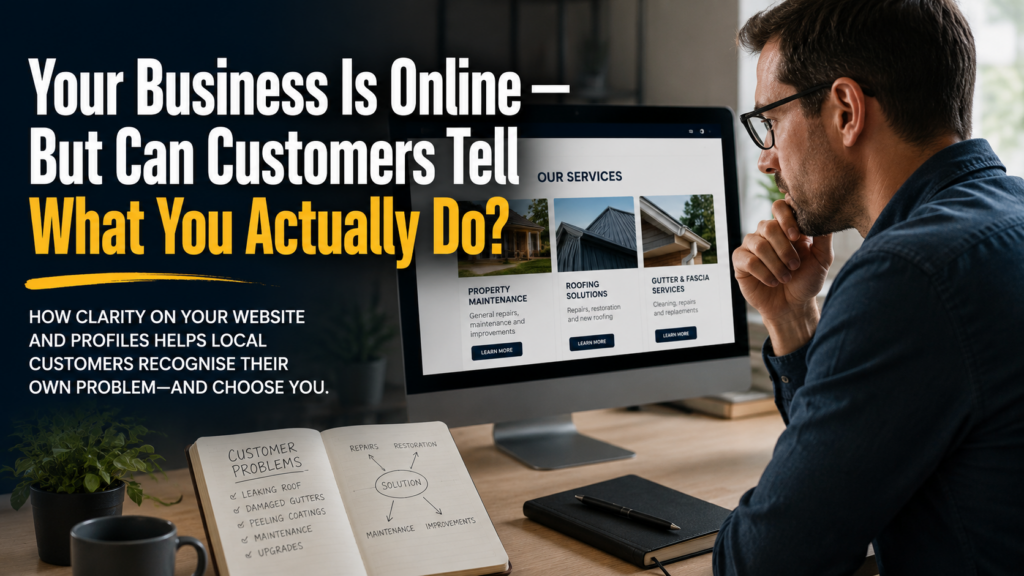
For many small businesses, getting online once represented the hard part. A website had to be built, a Google Business Profile created, a Facebook page maintained, perhaps an Instagram account added for good measure. Once those pieces were in place, there was a reassuring sense that the business could now be found. Its name appeared in search results, its phone number was visible, its services were listed and its photographs looked respectable. From the owner’s point of view, the business was clearly online and clearly open for business.
The customer’s experience can be very different. A person rarely arrives at a website thinking in terms of a company’s internal service categories. They arrive with a situation. Their pool coating is peeling. Their office needs new signage. Their accountant has retired. Their roof is fading. They need someone to repair a leaking tap before tenants move in on Friday. What they want to know is not simply whether a business exists, or even whether it operates in the right industry. They want to know whether this particular business understands and handles the particular problem sitting in front of them.
That creates an important distinction between online visibility and customer recognition. Visibility allows someone to encounter your business. Clarity allows them to recognise that your business is relevant to them. When that second step is missing, the customer is forced to investigate, interpret and make assumptions. Every extra piece of interpretation creates an opportunity for uncertainty, and uncertainty is often enough to send a prospective customer back to the search results.
Being Visible Is Not the Same as Being Understood
Business owners naturally see their own marketing through the knowledge they already possess. A plumber knows what falls under “general plumbing services.” A commercial painter understands what “protective coatings” might include. A marketing consultant knows what “digital solutions” means in the context of the services they provide. The customer may not share any of that background knowledge, yet many websites and business profiles are written as though they do.
This is why a perfectly accurate description can still be commercially weak. A company might describe itself as providing “professional property maintenance solutions throughout the region.” Nothing in that sentence is necessarily wrong, but it asks the reader to perform almost all the useful interpretation. Does property maintenance include repairing damaged gutters? Replacing rotten timber? Fixing a sticking door? Preparing a rental property between tenants? Working on commercial premises? The phrase identifies a broad category while leaving the customer’s actual question unanswered.
The problem becomes more pronounced because people comparing businesses rarely study every option with equal patience. They scan headings, service names, profile descriptions, photographs and snippets looking for evidence that one provider fits their situation. A business that makes that connection immediately has an advantage over one that requires several clicks and a phone call merely to establish whether the work is relevant. The distinction worth remembering is simple: being found puts you in the comparison; being understood gives you a reason to survive it.
Customers Search With Problems, Not Your Filing System
Most businesses organise services according to what makes operational sense. Their categories may reflect departments, trades, product lines, accounting systems or familiar industry terminology. Customers organise the same world differently. They think in terms of what has happened, what they need changed and what they are trying to achieve. Those two systems overlap, but they are rarely identical.
Consider a local painting and coating business. Internally, it might divide its work into “residential coatings,” “protective coatings,” “surface preparation” and “restoration.” A homeowner staring at a peeling concrete pool may have no idea which category applies. What they do know is that the existing coating is coming away, they want to know whether it can be recoated, and they are worried that the old surface may require substantial preparation first. If the business talks only about coating categories, the homeowner has to translate their problem into the supplier’s language before they can decide whether to enquire.
A stronger website closes that translation gap. It can still use technically correct service names, but those names should be supported by descriptions that connect them with recognisable circumstances. “Pool coatings,” for example, becomes far more useful when the surrounding copy explains that the business works with existing painted concrete pools, deteriorating coatings, recoating projects or whichever situations the business genuinely handles. The objective is not to dumb down professional terminology. It is to give customers enough context to place themselves inside it.
This is a useful mental model for reviewing marketing: your service name tells customers what bucket the work belongs in; your explanation tells them whether their problem belongs in that bucket. Businesses often provide the first and assume the second is obvious. It isn’t.
Vague Language Creates Work for the Customer
There is a particular kind of business language that sounds polished while communicating remarkably little. “Quality solutions.” “Exceptional service.” “Tailored outcomes.” “Your trusted local experts.” “Comprehensive services for all your needs.” These phrases survive because they are broadly positive and difficult to object to. They are also interchangeable across thousands of businesses.
The issue is not that such language is forbidden. The issue is what it replaces. If the most prominent section of a webpage tells a visitor that the company provides “innovative, reliable solutions tailored to your individual requirements,” valuable space has been spent without helping the visitor answer a practical question. A prospective customer still has to scroll, open service pages or contact the business to discover whether those solutions include the particular job they need done.
Broad service labels cause the same problem in a quieter way. Imagine a Northam business whose profile simply lists “Electrical Services.” A local property owner may be trying to work out whether the electrician handles shed power, safety switches, lighting upgrades, rental property repairs or fault finding. The business might provide several of those services, but the phrase “Electrical Services” does not confirm any of them. Another electrician whose website specifically describes the situations they handle may feel like the safer choice, even if both companies are equally capable.
This is where clarity affects more than readability. It affects perceived fit. Customers cannot evaluate expertise they cannot recognise. If your capability remains hidden behind broad terminology, the problem isn’t necessarily that prospects distrust you. They may simply fail to gather enough evidence that you are relevant before their attention moves elsewhere.
The “Can You Help Me?” Test
A useful way to review a website or profile is to stop reading it as its owner and read it as a customer with one specific problem. Choose a realistic situation that the business genuinely wants to attract, then imagine arriving with no prior knowledge of the company. Ignore everything you know about its history, staff and capabilities. Ask one question: Could I tell, quickly and confidently, that these people can help with my situation?
That question is more demanding than asking whether a service is technically mentioned somewhere on the site. A customer should not have to infer that “surface restoration” includes the job they have in mind or assume that “commercial services” covers their type of premises. Nor should they have to open five pages to assemble the answer from fragments. The evidence should appear where a reasonable person would expect to find it, using language recognisable enough to connect the business’s capability with the customer’s circumstances.
A compact diagnostic can make the exercise more rigorous:
- Can a new visitor identify the kinds of problems or situations the business handles?
- Are important service labels explained in ordinary customer-recognisable language?
- Can the visitor tell whether the service applies to their type of property, product or circumstance where relevant?
- Does the page answer obvious doubts that might otherwise force someone to call just to establish basic fit?
- Could a customer repeat back, in one sentence, what this business can help them with?
The last question is especially revealing. If a visitor can only say, “They provide quality solutions,” the marketing has described the business without defining its usefulness. If they can say, “They repair and recoat older concrete pools where the existing coating is failing,” the connection is considerably stronger. The point is not that every business should use that exact style of sentence. The point is that customers should leave with a concrete understanding rather than a collection of positive adjectives.
Specificity Does Not Mean Listing Everything
Once business owners recognise the problem, there is a temptation to solve it by creating enormous lists. Every service, variation, customer type and possible scenario gets added to the page. The result may technically answer more questions while making the business harder to understand. Clarity does not come from saying everything. It comes from choosing the information that most efficiently helps the right customer recognise a fit.
The best level of specificity sits between two extremes. At one end is language so broad that almost any business could use it. At the other is an exhaustive catalogue that overwhelms the reader. Strong marketing selects the situations customers are most likely to recognise, the distinctions that commonly create doubt and the services the business particularly wants people to understand. It then connects those ideas in natural language rather than burying them in a wall of keywords.
For a local business, this might mean explaining that a general service includes a handful of common jobs rather than listing thirty-seven minor tasks. For a specialist supplier, it might mean distinguishing which surfaces, applications or customer types a product is intended for. For a professional adviser, it might mean describing the kinds of decisions or problems clients usually bring to them rather than presenting abstract labels such as “consulting” and “strategy.” The right question is not, “Have we mentioned everything we do?” It is, “Have we explained enough for the right person to recognise themselves?”
That distinction protects the business from another common mistake: writing every page as though it must appeal to everyone. Useful specificity naturally excludes some readers, and that is not necessarily a loss. When a customer can clearly see that a service is designed for their situation, relevance rises. When nobody can quite tell who a service is for, broadness becomes ambiguity rather than reach.
Your Website Should Reduce Investigation, Not Create It
A good business website does not need to answer every question before a customer makes contact. Some services are complex, some jobs require inspection and some purchasing decisions need a conversation. The goal is not to eliminate enquiry. It is to make sure the enquiry begins at the right stage.
There is a significant difference between a customer ringing to ask, “Can you help me at all?” and a customer ringing to say, “I can see that you handle this type of job. Mine has these particular circumstances. What would you need from me next?” The second customer has already crossed an important threshold. They understand the basic relevance of the business and can use the conversation to discuss their actual situation rather than conducting preliminary detective work.
This means clarity should be considered part of the customer’s path to action, not merely a writing preference. Every vague heading, unexplained service label and generic claim asks the visitor to supply missing information. Sometimes they will. Sometimes they will call. Sometimes they will keep searching until they find a business that makes the answer easier to see. Owners often respond to weak enquiry levels by trying to attract more visitors, when part of the opportunity may lie in helping existing visitors understand more quickly what the business already offers.
A practical place to start is with the pages and profiles that receive the most attention. Read the opening screen, service names and short descriptions without mentally filling in anything from your own knowledge. Then choose three real customer situations you would be pleased to receive tomorrow. For each one, ask whether that person could arrive, scan the information and recognise their problem without having to translate your terminology or hunt for confirmation.
If they cannot, the next marketing task may not be another campaign, another social post or more traffic. It may simply be to make the business easier to understand.
The rule to keep is this: never make a good prospective customer investigate whether you can help them when you could have made the answer clear.
Your Bonus — Use This AI Prompt To Get More Ideas
Copy the prompt below, open your preferred AI tool, paste it in and replace the example information with your own details. Use the result to get more ideas and apply what this article just taught you.
Need Help With “Your Business Is Online — But Can Customers Tell What You Actually Do?”?
Knowing what needs fixing is one thing. Getting it fixed properly is another. If you’d rather have an experienced digital marketer help you work through the problem and turn the advice into action, Yazoogle is here to help.
Get Help From Yazoogle